Entrepreneurial Spirit At Ruff House Art

From day one back in 2009, Jill Shepherd of Ruff House Art had an entrepreneurial gleam in her eye as she started her business out of the basement of her home in southwest Kansas. Fast forward six years later, and you’ll find that Jill has expanded her letterpress company into a solid brick and mortar retail shop featuring the whirl of a 1915 Chandler & Price, the laughter of her daughter as she skirts through the shop, a full custom-invitation & wholesale everyday line, and of course, the warmth of Jill’s smiling face as she greets you when you come into the shop. We caught up with Jill between press runs to learn about her inspiration, how she got started, and what made taking the plunge worth it at the end of the day.

Ruff House Art shop

ROOTED DEEP IN THE MIDWEST I grew up in a small, rural farm town in southwest Kansas and went on to graduate from the University of Kansas with a BFA in Graphic Design in 2004. I spent several years working in marketing & branding as a designer. Coming from a family of farming entrepreneurs, I had always daydreamed about owning my own business someday.

Due to the struggling economy, I got the opportunity to pursue that dream when I was let go at my corporate job due to downsizing in early 2009. Initially, I envisioned doing what I had been doing, marketing, but on a freelance basis. During this time, I was asked by several friends to design wedding invitations and I quickly realized that was way more fun than corporate marketing! So, I said goodbye to the corporate world and went all in to the stationery world. I grew my wedding line, eventually added a wholesale/everyday line, and most recently expanded again with a brick & mortar retail shop!

Jill Shepherd of Ruff House Art

TRY, TRY AGAIN (AND REPEAT AS NECESSARY) At the start of Ruff House Art, I didn’t envision it turning into a letterpress company. I had taken a letterpress class as an elective in college, so I was familiar with the printing process, but I didn’t start Ruff House Art with a press from day one. About a year into it, I was gifted my first press by a friend’s family. It had been sitting in a warehouse for 30 years and they weren’t even sure what it was or if it worked. They asked if I wanted it and of course I jumped at the opportunity. It had been a while since my college class and I wasn’t familiar with this type of press (platen). I restored it and taught myself how to use it. It was a lot of trial and error, a lot of frustrations, a lot of asking other printers for advice and doing research, but eventually I found my stride and felt confident enough in my printing ability to add letterpress to my wedding line. Shortly after, I decided to add a retail line, focused primarily around letterpress.

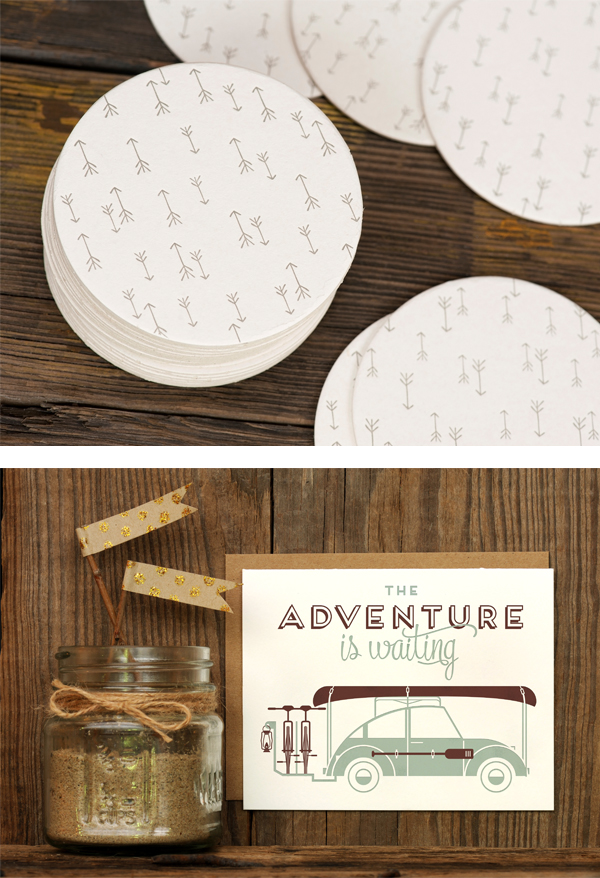
Letterpress coasters by Ruff House Art

Letterpress coasters & cards by Ruff House Art

WINDOWS TO THE WORLD Up until this year, our shop as located in the basement of our home. In November of 2014 we moved our presses to downtown Lawrence and opened up a retail brick & mortar shop with a print/production studio in the back. We have big windows that look from the shop into the studio so customers can see the presses in action. It has been so fun to watch the community get involved and to hear how many people actually have some connection to letterpress. Whether they have taken a class, their fathers/grandfathers were printers, or they used to own a press. We also get asked on a regular basis if we actually use the presses or if they are “just for show” which always makes me giggle. When we are pressing, people gather around and watch which is so fun (and a little nerve-wracking!). My very first press is still the press that we use the most – a 1915 10″ x 15″ Chandler & Price.

Letterpress wedding stationery suite by Ruff House Art

A STUDIO WITH MANY PREVIOUS LIVES Lawrence is full of history and Mass Street (downtown) is the heart of the city. Our shop/studio is located in one of the oldest buildings in the city, built in 1858. The building was built by the Miller family who were print makers (how cool is that!) and it briefly housed the first post office in town. in 1862 it was taken over by the House Family and ran as a clothing store. It went on to house a Furniture Store, Daylight Donuts, and a brewery. It amazes me to sit here and hear about the people & stories that have passed through the door and it is so fun to now be a part of that history.

Ruff House Art print shop & paperie

FAMILY AND LETTERPRESS COMMUNITY INSPIRED I am mostly inspired by my everyday life. My husband and our friendship, my daughter and her laughter and all the wonderful people I have met in the stationery industry. There are so many truly wonderful people in this industry and I love how it is more of a community that supports each other rather than a competition. I am driven everyday to make a positive impression on my daughter so that she will learn the value of hard work and determination, just as I did from my parents.

Ruff House Art work samples

FULL TIME AND THEN SOME I feel like I wear nearly every hat that could be worn. I am the designer & printer for Ruff House Art. I am also customer service, sales, shipping, buyer, retail associate & mopper. When you own a small business you tend to learn how to do everything and be able to juggle that work load.

In my dream world, I would have way more time to design, and my line would be constantly evolving and full of wonderful things. But the truth is, I have to pencil in design time and sometimes that gets pushed to next week!

Ruff House Art is my full-time career. It has been my full-time job since day 1 in 2009, and I have been fortunate to have grown it over the years to be able to support myself & my family. It’s tough, demanding and at times all consuming. This business (or any self-owned business I would presume) is not for the weak of heart. It takes dedication, hard work and lots of coffee. But at the end of the day, as I shut the lights off and lock the doors, it is all worth it – so worth it.
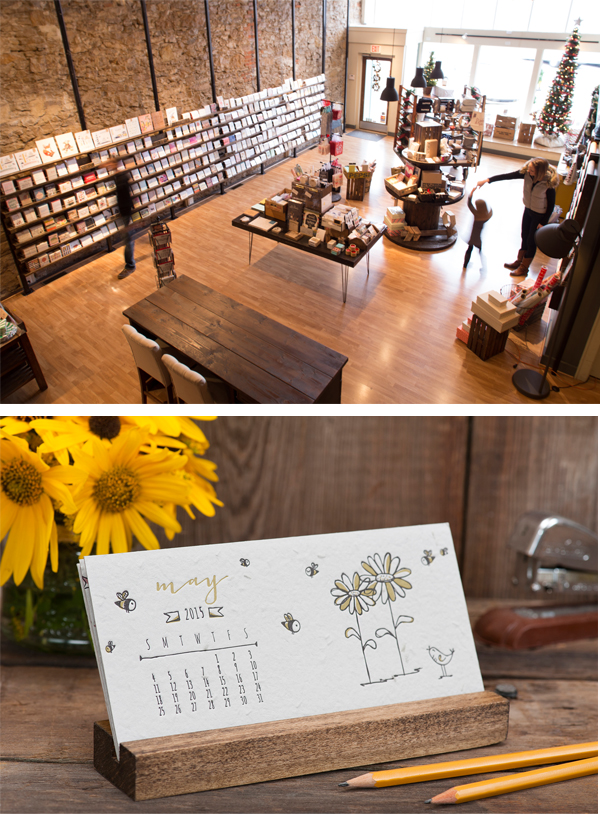
Ruff House Art shop

WHERE IDEAS ARE SPARKED As I said, I am inspired everyday by normal life. And often the start of a card or product is a seed that gets planted by something my daughter says or an experience I have had. Such as our “Eat Cake For Breakfast Card” – growing up, my mom would occasionally let us indulge a little at breakfast with a cookie or piece of cake or brownie.

I in turn do this with my daughter without even thinking, even though my husband about dies each time he sees me sneak a cookie to her at breakfast! So I thought, everyone should be able to eat cake for breakfast on occasion! A card was born. From the spark of an idea, I wrap up the design on the computer and send it off for the plates to be made and turned into a letterpress card.

THE COMPANY WE KEEP I am proud of so many things that Ruff House Art has accomplished over the years. We have been featured in some really great magazines alongside other great artists. And our garden cards were featured on the Today Show for Earth Day! I have also had the privilege and honor of working with some great national retailers such as Paper Source, World Market, Nordstrom & West Elm.

In addition, I have been nominated 2 times for the Louie Awards (once for our garden cards & once for classically printed wedding invitations). We took home the Louie in 2014 for Classically Printed Wedding Invitations. That award was even more special as it was won for the invitations for my husband and I!

Ruff House Art samples

BLAZING A TRAIL It’s funny, in my mind, I feel like I am always just kind of “winging it” in my own way. Since I was self taught, I feel like I likely don’t do things the same way other printers do. But who says there is a right and wrong way as long as it works! Since opening our public space, I do feel I have gained confidence in my skills & techniques, offering advice to others who are just getting started in the printing business.

A BIG TO-DO LIST The opening of the brick & mortar put a pretty big stall in the growth of my own wholesale line. It has been all consuming and demanding learning how to balance another facet of my business. But I do think things are smoothing out into a well oiled machine and I am really looking forward to getting back into the growth and marketing of my own line. Being in the shop everyday has also given me great insight into what the consumer is drawn to and really looking for. I am going to take that knowledge and grow my own line accordingly. I am really looking forward to a release of new cards and coming back to my own product line with fresh vision.

Huge round of thanks out to Jill for letting us take a fresh look into the wonderful world of Ruff House Art (and then some)!

Letterpress Blooms at Maude Press in Creative South Pasadena

Dee Cutrona of Maude Press is sustained daily by the artistic flavor of her community and the people she considers mentors. She recently welcomed us in for a peek at her studio and shared how she got her start in letterpress — as well as the path she’s set herself on for the future.

Maude_Press_Dee-IMG1

BY ANY OTHER NAME Well, I suppose the first thing you should know about me is that my birth name is Christen and I can thank my sister for calling me “Christie Dee” the first time that she saw me. This, of course was shortened to Dee and here I am!

NECESSITY DEMANDS ACTION I first got involved in letterpress when I met a gal, Mable, in a design workshop. She was operating a letterpress studio and we thought, hey, let’s start a greeting card line! And so we did, and we called it Dee&Lala. In a funny way, I learned letterpress out of necessity–we were selling cards all across the U.S. and abroad and printing all day to keep up!

Maude_Press_Dee-IMG2

LOCATION, LOCATION, LOCATION I print in a studio right in my neighborhood of South Pasadena. What’s so great about the space is that I share it with a cake company, so the smell of baking cakes fills the air and it’s a team of girls, so we have this nice camaraderie. My favorite thing about my studio is that it’s nestled among traditional craftsman homes and tree lined streets, so my commute, whether by bike or car, is idyllic.

Maude_Press_Dee-IMG11

WALKABLE AND WONDERFUL SOUTH PASADENA is a hidden gem. It’s like this magical little pocket of Arts and Crafts architecture, cafes, family friendly neighborhoods, lots of art, music, festivals, parrots — yes parrots — and small independent shops…including Annika Buxman’s De Milo Design Studio & Letterpress [check out the profile we did on Annika’s studio a while back]. It’s an 8 minute metro ride away from downtown Los Angeles, so, in my opinion, it’s the best of both worlds. We actually have a small museum up my street — Meridian Iron Works — wouldn’t that be a great place to print!

SAGE ADVICE I considered Mable as my first printing mentor, and since that I’ve learned so much more. I do have a friend in town, who has a beautiful, very traditional, letterpress studio. I assist him with his printing as much as I can and consider him not just a letterpress mentor, but a life mentor. I also had design and style mentors in my Gramie and Grandad. They lived life to the fullest, did it with style and I am influenced by that philosophy daily.

Maude_Press_Dee-IMG6

INSPIRATION + THE CREATIVE FLOW I do not print full time. My days and weeks are equally balanced between designing and printing. I am planning to print more pieces for retail, so I’m anticipating more time at the press. As much as I appreciate the authenticity of working with type, I’m just so wired to be able to tweak and manipulate words and images digitally, so my process is more modern. I’m a digital artwork to photopolymer girl. When I first started Maude Press, I was working with magnesium dies, but I quickly switched back to photopolymer for the consistency and because the process isn’t toxic.

I enjoy working with fun wedding couples like Sheila and Casey. They wanted chic and modern and since they wanted a map, we decided to play with layers, a pattern and die cutting to add dimension. So much opportunity to be creative!

Maude_Press_Dee-IMG10

PRIDE IN THE ROAD I’VE TRAVELED Launching Dee&Lala was a huge accomplishment. I am/was really proud of our brand and the illustration work that I contributed. A lot of that work was very personal to me, so it meant a lot that our line was so well received. I still have a stack of samples. I still truly love them, even after printing them over and over and over…

I am equally, if not more, proud of launching Maude Press. It has been a wonderful experience so far and now that I’m about 4 years in, I’m ready to take it to the next level. I love the custom side of what I do, so it’s truly been a pleasure.

Maude_Press_Dee-IMG5

THE FIRST LADY AND NAMESAKE I wish I could list off a tally of presses, but to date, my only press is Maude, my 10 x 15 New Style Chandler & Price. She’s a work horse, but I can’t say I wouldn’t mind a cylinder from time to time..maybe someday. Maude is named after a movie that is a personal favorite of mine — Harold and Maude.

Maude_Press_Dee-IMG3

Maude_Press_Dee-IMG4

MUTUAL RESPECT FOSTERS GOOD RELATIONSHIPS Not only is Boxcar super informative and amazing, you provide my plates and plant trees when I purchase enough! What I like most, though, is your true love for letterpress and the letterpress community.

SHARING FROM EXPERIENCE Acetate is my friend.  Not only is acetate great for packing, I actually tape it down to my platen to register my artwork. I tape the acetate to the platen, ink the form and print on the acetate and then I register the paper to the print on the acetate. It saves so much time and helps with those hairpin registration jobs.

I’m a fan of Van Son Holland Ink (rubber or oil), but if you want a good rich black ink, my friend introduced me to ‘Sable Black SO 1 lb.” from Graphic Supply, Inc. — it is THE best black I’ve printed so far. No need to add a little warm red to this black– it’s gorgeous au naturale.

Maude_Press_Dee-IMG9

Maude_Press_Dee-IMG7

LEAPING OFF THE PAGES IN 2015 This is the year that I’m finally ready to produce more products for retail (mainly for my own site and a few local shops). Nothing major, no reps or stationery shows, just exclusive MP products to share with the world. I have pages of ideas that I just have to bring to life–it will feel like old times. Oh! And this year, hopefully, I will finally actually print my own stationery and if I’m really on a roll…holiday cards!!!

Thanks Dee for the glimpse into Maude Press. You are moving ahead full speed and you embody a quote from your favorite movie  “Try something new each day. After all, we’re given life to find it out. It doesn’t last forever.”

LZW Compression File Prep for Letterpress Plates

For Adobe enthusiasts who use Photoshop to create their platemaking files, we’d like to introduce you to Lempel-Ziv-Welch, which is a simple algorithm known as LZW compression. LZW compression makes your file size smaller without losing any image quality. Have a 1200 dpi, 22 megabyte file? No problem with LZW compression. It can compress that file down to mere megabytes and sometimes even kilobytes. Why do you want higher resolution? So you can have text and images that are higher quality and pleasing to the eye when printed.

Here is how you use the gem that is LZW. If you have a Photoshop image or text that you need to bitmap for a platemaking line art file, follow these steps.

1. Open your file in Adobe Photoshop. Convert to grayscale via IMAGE > MODE > GRAYSCALE. Select Yes if a window asks about discarding color.

2. Check your image size via IMAGE > IMAGE SIZE. When this window opens up, make note of the Pixel Dimensions at the top. Look halfway down the page at the Resolution of Pixels/Inch. Is the number 300 or less? We can do better! Increasing your resolution can shave and smooth out the pixelation of your bitmapped image. Change your resolution to between 600 – 1200.

Adobe Photoshop file showing how to check image size resolution.

LZW-img2-a

LZW-img5-a

Did you see your Pixel Dimension make a big jump up? Don’t worry, LZW will take care of that later. Click OK to save this new setting.

3. Select LAYER > check to see if Flatten Image is showing. If yes, Click on this.

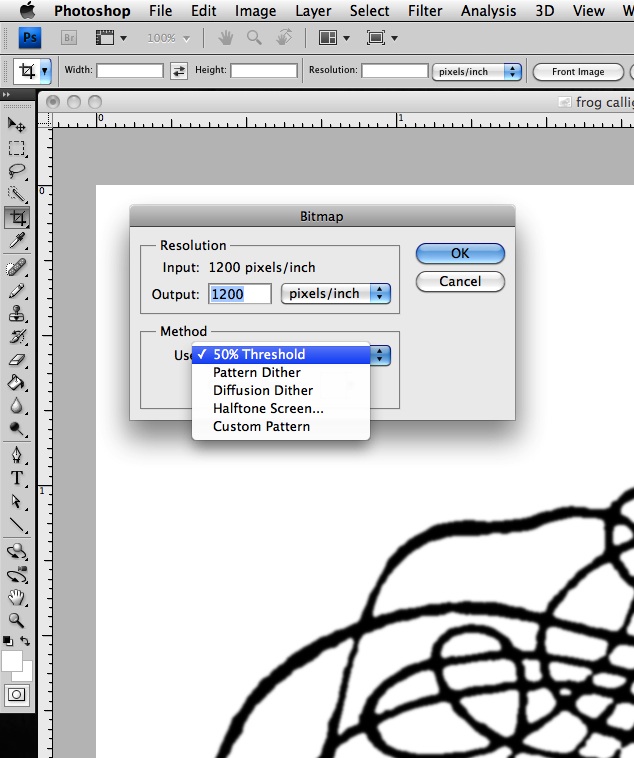
4. Click on IMAGE > MODE > BITMAP. A window will open to complete this step. Your input should match the resolution you just chose a few steps earlier. The Output should be equal to or greater than your Input (up to 1200 Pixels/Inch). Your Method should be 50% Threshold. If you are seeing Diffusion Dither (the default), click on the box to see other Method choices to find 50% Threshold. Choose OK. Your file is now in black and white in Bitmap mode.

LZW-img4-a

Saving to Bitmap made my file size smaller, you say? Yes, it did, but it is still probably many MB large. Imagine having 4 or 5 of these files and organizing all this artwork into one large document. Your new art board can quickly get unwieldy and oversized.

Time to save your file as a TIFF (.tif file extension) and tap into the power of LZW! TIFF is the format of choice for commercial and professional image standards. TIFF is the most universal and most widely supported format across all platforms, Mac, Windows

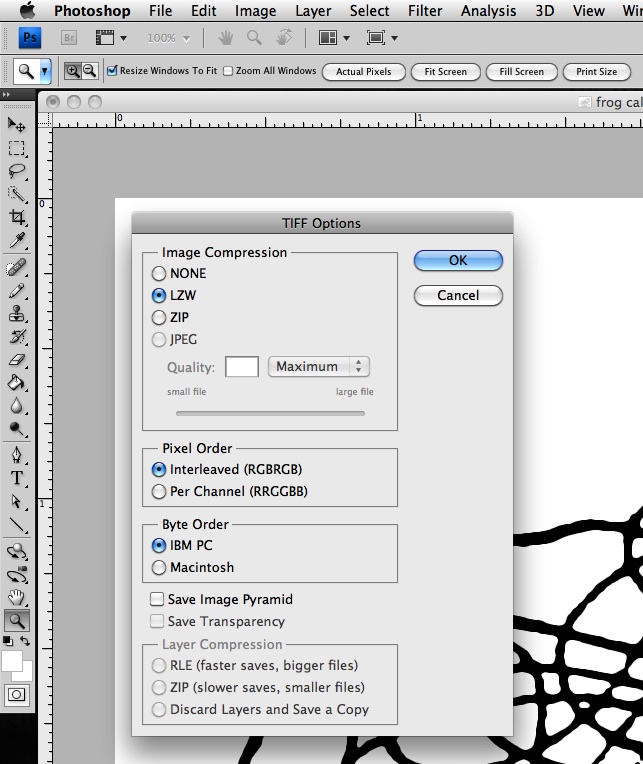
5. To finish up, Select FILE > SAVE AS . The pop up window is looking for your file name and a format. Choose TIFF. Another window called TIFF Options will open. At the top (for Image Compression) select LZW and click OK.

LZW-img6-a

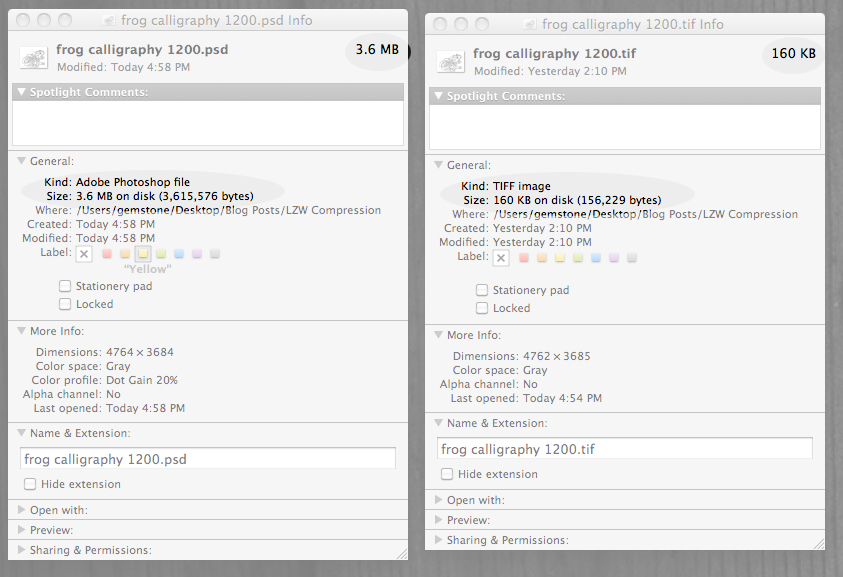
Check your folder where you saved your TIFF The size is now probably under 1 MB. Your TIFF document was able to be compressed with all the quality you desire but now in a nicely managed little file.

Comparison of two files and their data size: one is a Photoshop (PSD) file at 3.6 MB and one is a TIFF file at 160KB because of LZW compression.

Let’s See That Printed: All A-boot Kamikin

When we received Kamikin’s first order for plates, we had to get the back story – we loved their dynamic artwork and had to learn more. This family owned operation has quickly transformed from a pet project to a full fledged printmaking business. Marvel at their artwork while we tell you the rest of their tale.

Photopolymer letterpress printing plates being made at Boxcar Press in upstate New York.

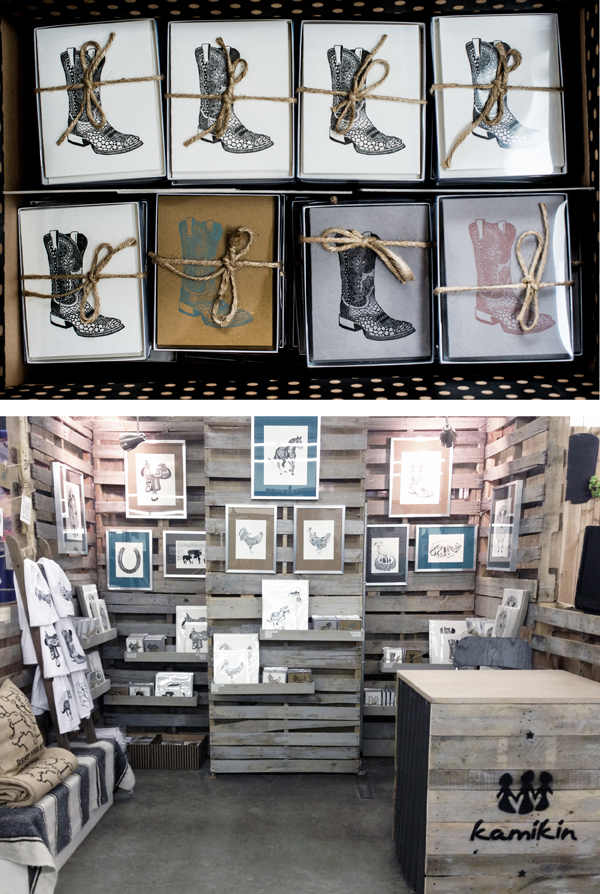
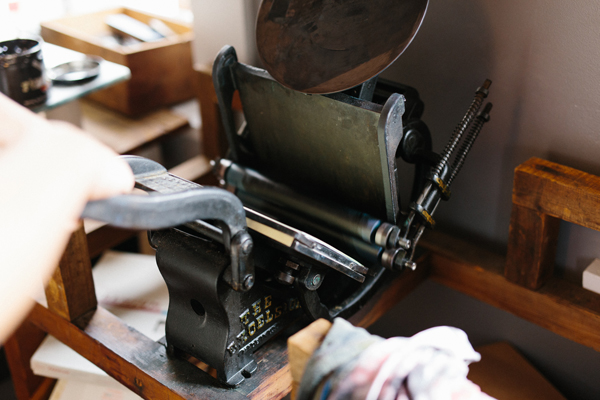
A quick history: Kamikin is the dream child of three sisters, Karen, Betsy and Susan, of Sedalia, Colorado.  Betsy and her husband acquired a 12×18 1920 C&P platen in 2012 with a goal of entering the fine art market with unique and affordable prints. The business plan revolves around the beautiful pen and ink drawings of both Betsy and Susan, and is driven forward by the go-getter business savvy of their older sister Karen.

Hand-drawing & illustrating designs for letterpress photopolymer plates and letterpress printing with Kamiken.

The artwork came together during the fall of 2014 with a western theme. This particular “Zen Doodle” series is western/folk art with a modern twist. Zen doodling consists of decorative lines that can have beautiful results when printed on a letterpress. Kamikin didn’t hesitate to shoot for a very competitive show for their first foray into selling, the 2015 National Western Stock Show, in their backyard of Denver. Betsy readily admits they were not actually prepared for a 16-day show. “Because of this, when we got accepted, our studio burst into a flurry of activity! We had to finalize our art, order plates for the letterpress, purchase loads of paper and packaging, and build a booth! It was a quick learning curve for all three of us as we cranked up the press for mass production.”

Letterpress printing with photopolymer plates with Kamiken on a C&P press.

“During this whole process, one of the most exciting steps was when our first order of polymer plates from Boxcar arrived,” says Betsy. “At that moment, it seemed that everything we had planned was now possible. With the artwork for this series done, the paper cut, and a printing schedule on the calendar, it was time to buckle down and get our hands dirty. With 8-10 hour printing sessions, we learned so much so fast! Like it’s a good idea to tag team the chase to save on your shoulder muscles.”

Beautiful letterpress printed western - themed cards from Kamiken.

In the 6 week timeline, they fell in love with the process. In one month, they went from having zero inventory to 2,700 packaged pieces of beautiful art to sell.  Over the 16 days at the show, they loved talking with people about letterpress and screen-printing. The prints and stationery were very well received. They even had a little movie playing in the booth to show the customers what a letterpress looks like and how it works. Overall, their debut at the National Western Stock show was a success.

Since January, the trio has put together a website and an Etsy shop. They have enjoyed donating several prints for various auctions to help support their community. And with more plates on the way, the team will be busy building up their inventory for the summer art shows and festivals.

Printing Traditions at The Tympanum Press

When you step over the threshold of the warm & cheery Goshen, Indiana apartment that houses The Tympanum Press, you find yourself surrounded by the delicate smell of ink, the intoxicating jingling laughter of Amy & Richard Worsham’s daughters, and a Kelsey set-up lovingly in the living room (next to the accoutrements of a shop that’s steeped deep in family printing traditions). We sat down with the husband-and-wife duo to talk shop, printing at home, and the joys of leaving the house with relatively clean fingernails.

Amy Worsham of The Tympanum  Press

HOME-STYLE PRINTING I’m Amy Worsham from the The Tympanum Press. My background is in graphic design, with experience in bookbinding and paper making. I homeschool our two youngest girls and operate our press out of our home in downtown Goshen, Indiana.

THE INK RUNS DEEP My husband has printing ink in his blood. His great-grandfather took to printing early in life and as a boy earned enough to pay for his small press and buy a bicycle before leaving school. He went to work for Joseph Bryan, a prominent Virginia newspaperman, who shortly after acquired the Richmond Times. He was sent to New York by Bryan to learn the operation of the linotype machine and met its inventor, Ottmar Merganthaler, in Baltimore on his return trip. In 1892 he set up the first linotype machine in Virginia, and eventually went on to found the Richmond Press, which he ran into the 1940’s. We still use the Kelsey Excelsior that he bought for his son, Richard’s grandfather, who in turn ran it as a job press for many years. In 1998, Richard trained under Walter Clements at the Rugby Print Works and had been running the press since then on small jobs for friends and family.

We started working together shortly after we were married to bring in a little extra money while we were still in college. We didn’t advertise and considered ourselves mostly a hobby press, but were amazed at the interest in our work. Graduate school drew us to South Bend, Indiana in 2009 where we decided to open as a job press. Since then, we have gradually expanded our portfolio from business cards and invitations to everything from broadsides to even small books.

Letterpress printing from The Tympanum Press

CLOSE TO HOME Our print shop has always been run out of our apartment. We have our old reliable Kelsey 5×8, so we’ve always managed to set aside a corner of our living space dedicated to our press. Recently the area needed for our press space has increased as we’ve expanded our line by taking in more jobs from online sales sources like Square Marketplace and Etsy.

Our current workspace is what some might call a living room. The press, tables, shelving, and equipment take up most of the space, but since both Richard and I are self-employed, we don’t have much time for lounging around anyway. It is truly amazing how much can be accomplished with the right attitude and well-made equipment, no matter what size.

Amy Worsham + letterpress printing from The Tympanum Press

DESIGNED TO PRINT My background is in graphic design. Richard takes the side of the cranky printer, and enjoys setting in cold type with a light impression, while I have brought the adaptability of digital design and graphic arts training to our letterpress process. Our goal is to pair the tradition of printing with modern techniques and create things that remind us of the power of the printed word.

THE CREATIVE PROCESS Depending on the project I’ll either grab a pencil and start sketching or go straight to the computer. For many of our cards and graphics I use Adobe Illustrator, but I also do a good number of linoleum block cuts on or off the press. For custom projects, I like to start with a number of precedents, honing it in with a pencil and paper, and finally moving to the computer for a final pre-proof design.

FULL TIME FUN Since starting the Tympanum Press, we have transitioned from small jobs, mostly for fun, to part-time job printing, to regular work, but in the last year it has become a full-time operation for me. As orders continue to come in, we are looking for a larger press and additional equipment, as well as space outside our home. It is amazing how far we have come operating the press just like those old advertisements promised in the 20’s.

Letterpress printing at The Tympanum Press

PRINTING FEATS Gosh, this question is tough. Sometimes in our hectic schedules mixing the perfect color is an accomplishment… Sometimes leaving the house with relatively clean fingernails is an accomplishment!

PRESS HISTORY We’re still printing on our very first press, the reliable 5×8 Kelsey Excelsior. Richard was trained on a Pearl and we are definitely looking for a larger floor press. We never had the space since we’ve always printed out of our home, but since we’ve gone full time I am very excited at the hugely expanded potential of a larger press.

The Tympanum Press prints with a 5x8 Kelsey Excelsior

BOXCAR’S ROLE Photopolymer plates, especially with the Boxcar Base, have allowed me to tailor our printing to our community and combine my love for design with the versatility of letterpress. Boxcar has allowed me to create a cohesive line of products within my budget.

SHOP TIPS Never rush a print job. Take your time. When nothing is working, clean it all up and start again.

Letterpress printing from The Tympanum Press

WHAT’S NEXT 2015 is going to be a great year for us. We’re not only investing in a larger press and plenty more lead type, but we also have big plans for much more platemaking through Boxcar as way to get many of our customers the types of stationery styles they are looking for.

Huge heaps of thanks out to Amy and Richard for letting us take a sneak peak into the wonderful world of The Tympanum Press!

(photography courtesy of Grant Beachy)

Have Press, Will Travel

Meet Erin Fae, a self-proclaimed dreamer and printer. Last year, she dreamed of putting a new spin on letterpress. With visions of a traveling tabletop press and a new set of wheels, the Press Cycle project began. Erin explains how her idea took off with the help of others who shared her slightly unique vision.

Erin Fae of the Press Cycle

In 2013, I bought an 8×5 Adana on Trade Me from a woman in Christchurch, New Zealand. She was so excited that the press would help teach people printing at Alphabet City (the community art space I used to run) that she offered me a bonus press for free: an Adana 5×3. As soon as the small press came into our lives, I knew this gift presented an opportunity to be able to share letterpress printing with even more people than those who wandered into our studio.

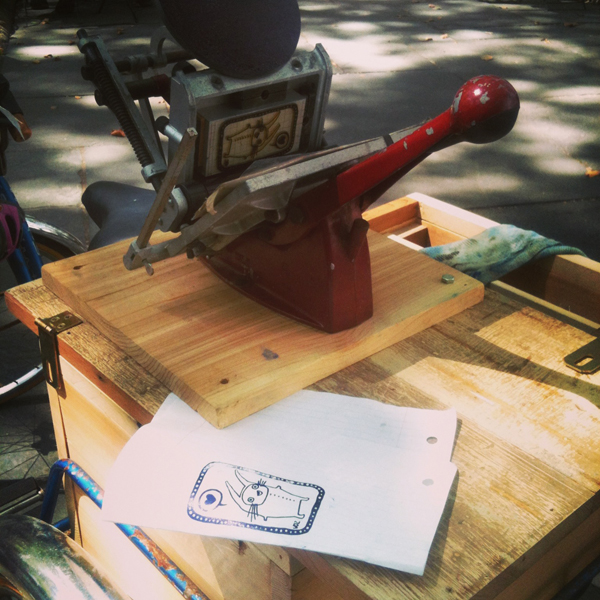
I was returning to my beloved home of New York City for the summer of 2014. I knew I wanted to run a portable print project that would take letterpress printing outdoors and into various communities. I wanted to expose as many people to letterpress printing as possible and find a way for people who had never heard about letterpress to try it out.

The dream came to fruition with the help of Press Cycle Kickstarter and over a hundred backers.

I called the project The Press Cycle: Letterpress on Three Wheels. Running the Kickstarter meant I was able to purchase a vintage Schwinn Tri-Wheeler adult tricycle and outfit it with a custom box (built by the super talented folks over at Nightwood in Brooklyn that converted the tricycle into the mini studio). I had originally thought that the project would use magnesium dies for printing…and had started an order when I got a pretty magic phone message.

Letterpress printing by The Press Cycle The Press Cycle in NYC

When Boxcar told me that they wanted to donate a base and a page of plates, I was beyond thrilled. By nature, I am every shade of enthusiastic: I had a solo dance party in my borrowed Brooklyn apartment. This wasn’t just because the donation helped the project immensely, but because the Press Cycle is all about collaboration. I wanted every stage of the project to be about collaboration and community, and teaming up with Boxcar meant this was evermore true.

The Press Cycle on tour

The project wrapped up in September. How did The Press Cycle go on the slightly more inky streets of New York? I think it went marvelously. I said from the beginning that even if one person learned about letterpress, all the work would be worth it. By the end of the Summer, not one person, but hundreds of people in different Brooklyn and Manhattan neighbourhoods got to try out letterpress printing. We even took the press to the Greenpoint branch of the Brooklyn Public Library for their Greenpoint Handskills workshop.

I love teaching printing and one of my favorite things in the world is watching people pull their first print. Even if they’ve watched someone else do it, even when they know what is going to happen, doing it themselves is always a wonder. One woman told me that she needed something to make her day and that the Press Cycle did it. An older man in Brooklyn told me about how he printed on a hobby press in high school. Young children were especially amazed at the instant nature of printing, that they could pull one lever and make an image—no waiting for something to come out of a machine; they had the power to do the work.

Erin Fae of the Press Cycle

I handed out pamphlets to anyone who printed since most people didn’t have time to hang out and chat. I wanted everyone who encountered the Press Cycle to know that they were helping keep letterpress printing alive and are part of a long lineage of printers, even with just that short encounter. All printers matter. I hope that some of the folks who tried letterpress for the first time went on to learn more about printing. Who knows?

Letterpress printing samples from The Press Cycle

Maybe someone will take a class, maybe someone will one day have their own press.

It wasn’t all roses. Before I put up a giant laminated sign that said “FREE (Yes, really)” it was sometimes hard to lure people into printing since New Yorkers were suspicious that I was selling something. Also, I was somewhat limited by being a human. I didn’t have the power to wheel the 100+ pounds of Press Cycle as often as I would have liked, and needed to give my body time to rest and recharge.

Letterpress printing with The Press Cycle

What was always amazing was the community that came together around this project. I collaborated with various artists to make the images for the plates; Boxcar’s amazing donation; the enthusiasm of letterpress printers online and off; and the amazing backers on Kickstarter. People coming together around learning and creativity is always humbling and wonderful. I feel grateful that I was able to lead a project that gave so many people a peek into the world of printing and how letterpress works.

Hitting the Mark With Ted Ollier

A whirlwind of creative energy, Ted Ollier of the Bow & Arrow Press & Mindhue Studio is a creative tour-de-force who loves blending art & education via letterpress (and with gusto we might add). When he’s not getting students and the letterpress-curious up to speed at the Crash Courses and Open Press Nights found at the Bow & Arrow Press at Harvard University, Ted moves deftly from part-time teaching to pursuing his own fascination with typesetting, designing conceptual artwork, playing bass, and the enjoying the thrill of finding type still wrapped in foundry sealed wax paper. We caught up with Ted amidst the fun to see why the fascination with printing still reigns supreme.

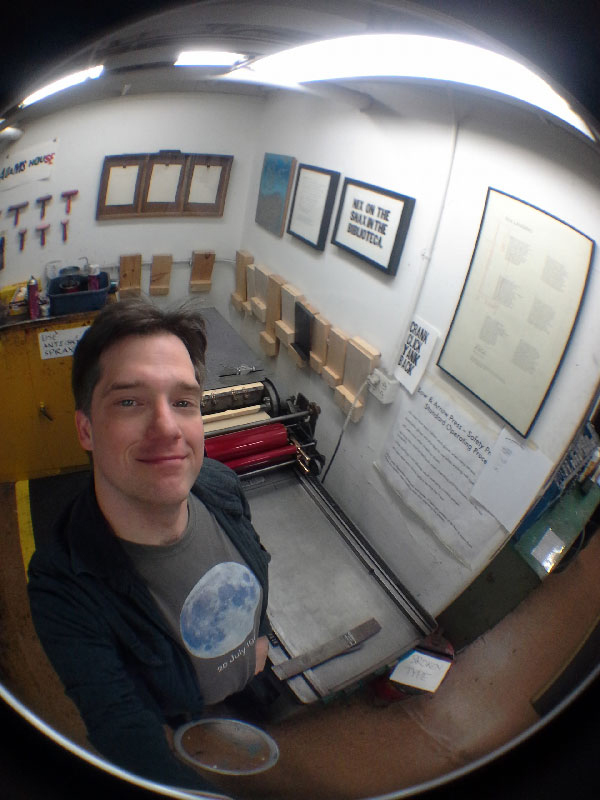
Ted Ollier at Bow & Arrow Studio on the Harvard Campus

PRINTING DEXTERITY I was born in Toledo, moved to Austin during the 80’s Rust Bowl, and moved to Boston in 2008. I have a BA in Liberal Arts from the University of Texas at Austin, a BFA in Studio Art and Communication Design from Texas State University, and an MFA from Massachusetts College of Art. I’ve been a designer, prepress technician, type designer, printmaker, photographer, bass player and artist at various times in my life, sometimes all at once. My BFA concentration was in metalwork and fine art printmaking, and I worked prepress and design in a small offset litho shop in Austin while I was getting that degree. That dual experience — seeing printing both as an art and as a business — definitely has come in handy dealing with letterpress.

LOVE AT FIRST SIGHT A friend of mine was running the Bow & Arrow Press, a letterpress shoehorned into the basement of Adams House, a residence hall at Harvard University. When I moved to Boston, he asked me if I’d like to take it over, as he had other projects coming up. I did, and the rest is history.

THE PRINTING BEAT IN BOSTON We’re shoehorned into three-and-a-half connected rooms in the basement of the Adams House Residence Hall. Odd corners, protuberances, closets and shelving are just part and parcel of the Bow & Arrow experience. We have a Vandercook No. 4, a Vandercook SP-20, an old Vandercook roller press, a C&P Pilot tabletop press, a Charles Brand intaglio press, and two museum pieces: a C&P windmill press and a Pearl treadle press. The Pearl is, alas, too fragile to run and I don’t really trust the C&P around so many inexperienced people, so they stay quiet. The Charles Brand intaglio press is our most recent addition, donated by a printmaking colleague of mine, and it’s nice to be able to demonstrate forms of printing even more obsolete than letterpress.

Ted Ollier at Bow & Arrow Studio on the Harvard Campus

Our type is old and has not always been handled properly, but that doesn’t stop people from setting amazing things with it. Some of my favorite faces in our collection are a nice selection of Futura Light, a nice selection of Stymie, a case of New Century Schoolbook, and a case of Kennerly Italic. We also have more than 500 printing plates and linoleum blocks in our library.

Packages of type at Bow & Arrow Studio on the Harvard Campus

We have the full complement of rubber-based PANTONE inks, and have an uncoated guidebook for mixing custom colors. We use California Wash, NTT type wash, and Super Rubber Rejuvenator. I’ve heard there is some controversy about SRR in letterpress circles, but judicious use over the last five years has kept my rollers looking as smooth and matte as the day we installed them. We have a small manual Challenge guillotine cutter, and the usual complement of composing sticks, pica sticks, leads, spaces, coppers, chases, quoins, keys and other ancillaries.

THE CREATIVE PROCESS I’m both a designer and printer. It depends on if it’s for a commercial job or for my own artwork. The commercial jobs tend to be relatively straightforward: legible type, minimum of ornamentation, some judicious color if that’s what the client wants. These days it’s an uphill run explaining the concept of spot color or the limitations of the letterpress to people who are used to immediate CMYKOG inkjet printing, but it usually works out to everyone’s satisfaction. I definitely subscribe to the idea that design is there to facilitate the transfer of information, rather than a chance for an art director to demonstrate some faddish stylization or pointless gingerbread.

My own artwork, on the other hand, is heavily conceptual and very intellectual. I spend quite some time tweaking and mulling the concepts that I find intriguing and compelling, and then thinking about what’s going to end up on the paper. That said, I try as best as I can to distill things down so that someone seeing the images for the first time will find them interesting enough to explore the concept further, rather than be put off by a hermetic sterility or ivory-tower isolation. My main intention is to get people to see these ideas in the same fascinating light that I do. This desire to show and share interesting information about the world keeps me from getting too far into outer space — at least that’s what I hope.

Ted Ollier's letterpress printing samples

Ted Ollier's letterpress printing samples, plus lead type at the Bow & Arrow Studio

FULL TIME FUN I also teach part-time, and have a day job doing scanning and Photoshop work, along with some intermittent design. I’ve taught printmaking and intro graphic design, and recently I’ve been able to use the Bow & Arrow Press to teach letterpress and intaglio. That’s wonderful because I’m able to keep the Press busy and engage students in a more formal teaching environment than our informal classes and open press hours. Plus, the heightened visibility of the Press has allowed us to work with people from all over campus, including the Harvard Summer School, the Harvard Extension School, the Graduate School of Design, and the Department of Visual and Environmental Studies. Printing is only one of the several hats I wear, but I’d love to do more of it.

Bow & Arrow Studio on the Harvard Campus

PRINTING FEATS When I got to the Bow & Arrow Press, it was somewhat underutilized and chaotic, and although I had printmaking experience, I didn’t have much printing experience. In the last six years, with the help of many of the people who run Adams House, I’ve been able to grow the Press into a bright, busy, organized place. Since we reside in a undergraduate dormitory, we are required to have Open Press Nights where students (and others) can come to see what this obsolete printing process is all about. Through weekend Crash Courses supplementing these Open Press Nights, we’ve enabled the Press to accrete a growing population of people who keep coming to explore not only typesetting, but also bookmaking, relief printing, engraving and drypoint, page layout and imposition, and many other things. Through all of this, and probably because of it, I’ve also been able to find my way toward gaining experience as a letterpress printer. Nowadays, I’m very pleased that I can run multi-color tight-registration jobs with a reasonable throughput on both our Vandercook No. 4 and Vandercook SP-20.

Classes at the Bow & Arrow Studio on the Harvard Campus

PRESS HISTORY The first press I ran was the Vandercook No. 4 that has pride of place at the Bow & Arrow Press. It’s still my favorite. It’s small, but it’s bulletproof, and I’ve been very pleased with the registration I’ve been able to get on what is supposed to be a proofing press.

BOXCAR’S ROLE Boxcar Press has been an integral part of this whole thing from the very beginning. I know that letterpress people are supposed to extoll the romance of cold lead type and disown anything digital, but when you’re running a four-color design with modern typefaces, complex line art, and a final emboss, it’s time to examine one’s base assumptions. It’s the final product that really matters. Designers can be just as obsessive with thousandth-em kerning in Illustrator or InDesign as they can be with coppers or brasses, and with OpenType glyph sets, you have more ligatures, swashes and ornaments than you really know what to do with. That’s not to say I don’t bliss out when sitting down to typeset with the font of Standard Italic 18-pt that I found at Letterpress Things in Chicopee still wrapped in foundry-sealed wax paper and binding string, but one has to recognize that there are things that formalized lead typesetting cannot do.

Lead type

Since I have an extensive technical background in prepress, I haven’t needed the help of Boxcar Press in solving problems, tweaking designs, and fixing trainwrecks as other people might, but I think that’s a bonus for both of us. I think of Boxcar just as I did about the service bureau where I used to get film positives and offset printing plates made back in the day: I send you my files, you process my files, you send me my plates, and I run them. No fuss, no muss. In the five years I’ve been using your services, I’ve only ever had one hiccup in the process, and that was dealt with swiftly. I can’t think of higher praise to give.

SHOP TIPS Running a Press with a substantial public component takes patience and care. At any given time there are probably three or four people in the shop who have never touched a piece of lead type in their lives. Although I have Student Pressmasters and kindly regulars to help smooth over the bumps, the Crash Courses that I started teaching in 2009 have really kept the worst kinds of newbie mistakes to a minimum.

WHAT’S NEXT Recently, some of my regular Open Press attendees and I were able to purchase a Vandercook SP-20 for a joint-use project. We’re still looking around at lease options and way of organizing the business, but our intent is to take some of the lessons learned at the Bow & Arrow and pursue them in an independent venue. Will it become a full-time printing gig? We shall see, as I still love the Bow & Arrow and everything that surrounds it.

Huge round of thanks to Ted for letting us get a sneek peek at both the Bow & Arrow Press and Mindhue Studio!

A Printing Tradition: Sargent Brothers Press

Since our last visit with ever-charming Ben Sargent of Sargent Brothers Printers & Typographers, we toured his wonderful Texas-based printing abode. A few printing treasures and tools may have been moved around & added to, but Ben’s cheerful demeanor while printing on his C&P 10×15 Old Series has never missed a beat yet. We caught up again with Ben between ink runs to see how the printing tradition still runs strong in his family (like father, like son), why the down-home feel of a good letterpress print shop can’t be beat, and scored some nifty inking tricks to use on an older platen press.

Ben Sargent smiles wide in his Austin, Texas-based letterpress print shop (Sargent Brothers).

INK IN THE BLOOD I was born and grew up on the windy plains of the Texas Panhandle, where I learned the printing trade from my father. After getting a journalism degree from the University of Texas and putting in a few years as a reporter, I spent the next 35 years drawing political cartoons for the Austin American-Statesman. Retirement from that job gave me ample time to pursue my original trade, and I am enjoying it hugely.

Beautifully letterpressed blue and white wedding invitation featuring hand illustrated flowers is printed by Sargent Brothers out of Austin, Texas.

TEXAN TREASURE I’m fortunate enough to have a big enough property in South Austin to have built a nice little house (my one architectural accomplishment) as a home for the printing shop, and it is very satisfying to have a space built just for printing, not in the way of anything else. (Okay, it does also include a model-railroad layout along the walls above the type cabinets.)

Beautiful signage hangs on the door for the Sargent Brothers press shop in Austin, Texas.

FOR THE LOVE OF LETTERPRESS My father and his brother (the original “Sargent Brothers”) took up the trade as teenagers in Fort Worth in the ‘20s, and while newspaper careers took them both away from printing for many years, my dad got back into the trade when I was 12 years old. He purchased a Kelsey outfit with which he taught the craft to me and to my brother. Three years later, he brought the C&P 10×15 Old Series job press of his boyhood back home, and that is still the press I use today.

DESIGNED TO PRINT I enjoy designing printing, especially if it’s with metal type, but for almost all my commercial jobs I defer to the excellent creative efforts of the several graphic designers with whom I work.

Eye-popping color comes to life via Ben Sargent's lettepress wedding invitation pieces.

FULL TIME Since my schedule is my own these days, I guess one could say that printing is not only full-time, but 24-7, since I can take care of a client’s needs whenever fits their schedule. It’s been thus since I left regular syndicated cartooning a year or so ago, freeing me up to devote more time to the trade.

PRINTING FEATS I see that as the goal, however imperfectly achieved, of every job we do, to give the customer something we’re proud to stand behind. Still, there are certainly some pieces we’ve done over the years that do stand out, and I have a particularly fond regard for the various little handset books we’ve published (including two editions of our specimen book, and a brief history of the platen job press, published to commemorate the centennial of my press back in 2005).

Ben Sargent of Sarget Brothers sets up his Kort Guage Pins for his next printing run in Austin, Texas.

BOXCAR’S ROLE Oh, goodness, since almost all my commercial jobs are printed with Boxcar plates, it’s fair to say Boxcar is the sine qua non of our business. The plates themselves are always flawless, of course, and the service always timely, but by far the best part is the personal touch by which the staff, particularly Rebecca Miller, are always available and cheerfully willing to help us through the occasional digital-file nightmare, etc. I know you must have other customers, but I am always made to feel like Boxcar is there just waiting to meet Sargent Brothers’ needs. Thanks!

FIRST PRESS I learned the fundamentals on a Kelsey 5×8 Excelsior.

SHOP TIPS I think every printer, particularly one such as I who mostly works by himself, probably comes up over the years with dozens of tricks and techniques as he puzzles his way out of particular problems and situations, until they become just part of the craft, and he forgets they were once experimental innovations.

I can think of a few we’ve come up with, and they are probably worth some separate blog entries, so I’ll just cite one we’ve been having some luck with lately. Everybody who uses one of the older platen jobbers such as ours knows that the relatively unsophisticated inking system sometimes requires a little ingenuity in the case of relatively broad inked images. (Not big, huge color floods….with those I have learned the wise adage of one of my colleagues that “in letterpress, sometimes it’s okay just to say no.”). But for reasonable-sized bold areas, I’ve found they can be conquered with a couple of drops of something like Smooth Lith in the ink mix, and with providing a soft place for the impression to land, either by putting a couple of sheets of newsprint between tympan and pressboard, or even pasting some newsprint directly on the tympan (particularly if one is just trying to cover some limited areas). Also helps to “skip-feed” the pieces, so the ink has a little extra time to recover between impressions, and in some cases to go to the trouble of making the design into two press runs, one for the bold areas and one for the finer images. And I’m always receptive to anyone else’s ideas for this conundrum!

WHAT’S NEXT Job work has reached a fairly steady and comfortable level over here, and we look forward to getting the word about our offerings further out by word-of-mouth and our website. I’ve also had the privilege of working with a few young newcomers to the trade, and hope to continue in that way to keep letterpress thriving and growing.

A mighty round of thanks go out to Ben of Sargent Brothers Printers & Typographers for letting us take another peek into his sublime printing paradise.

DIY winter wonderland letterpress printed paper trees

With the temperatures dipping down in the freezing range these days, why not cozy up this holiday season with your very own forest of delightful paper trees? We offer a sparkling tree design but invite you to decorate your own using our blank tree template. We letterpress printed ours in an icy blue ink and handed them out at a recent open studio event for visitors to try.

tree-photo-2-1

Download your copy today as all are free for use. Each file is formatted to print on 11″x 17″ paper and is rated as beginner skill level. We recommend using a glue stick on the tabs to secure the different levels together, and found that tape can sometimes come in hand to secure any stubborn branches.

Templates:
With sparkling snowflake design: EPS & PDF
Design your own decorations (plain): EPS & PDF
Hint: dotted lines indicate fold lines and solid black lines indicate cut lines. Enjoy! 

2014 Letterpress Printer’s Holiday Wishlist Roundup

The winter holidays are upon us and we’ve got you covered for that special printer & letterpress aficionado in your life. Check out our favorite holiday letterpress gifts, printing must-haves, and a few DIY letterpress presents. Share your favorite letterpress gift ideas in the comments section below!

2014PrinterWishlist-IMG-A

1. Metal or wood Type from Etsy (don’t forget type cabinets to hold your finds!) | 2. Letterpress printing press t-shirts from Boxcar Press (to declare your printing love) | 3. New tree-free paper from Reich Paper – Aveo (made from sugar cane). | 4. Paper Micrometer on Ebay (a handy must-have tool for measuring paper thickness)  | 5. Letterpress Fabric from Michael Miller Fabric (to brighten up any pressroom)  | 6. Clampersand by Hand-eye Supply (hold down paper in style with this clever c-clamp)

2014PrinterWishlist-IMG-B

7. Downloadable letterpress poster files from the Museum of Printing (get crafty: print out & frame to your heart’s desire) | 8. DIY Typography Lantern from Font Crafts (Make your own tailored lantern!) | 9. Pantone 2015 Color of the Year: Marsala Coffee Mug by Pantone (sip in style this year) | 10. Beautiful printing apron from the Ladies of Letterpress (tres chic!) | 11. Bamboo typography rug from Ebay (comes in 3 sizes) | 12. Swing Away Lay Gauge from Boxcar Press (for that hard-to-gift-for Heidelberg Windmill aficionado)