Heidelberg Alert – Printing Press At Work On Screen

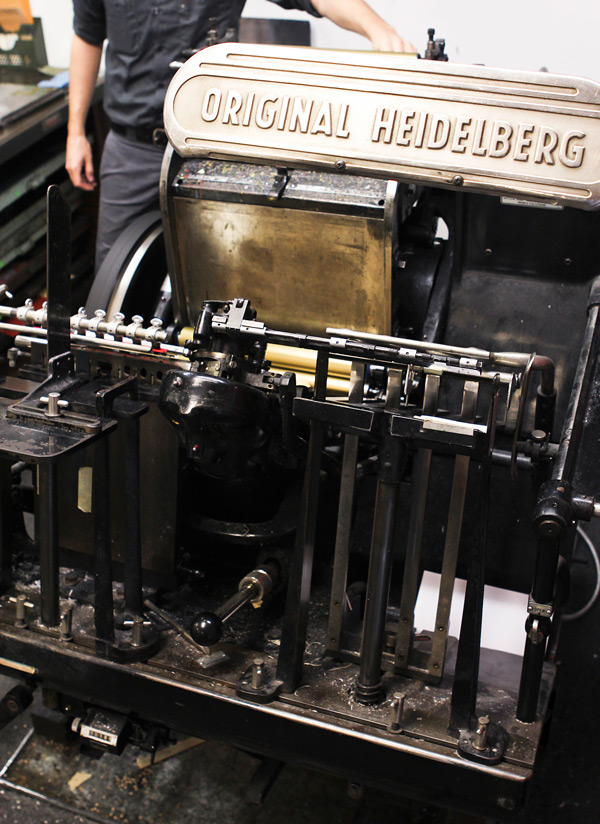
Though the popular USA Network series “White Collar” is now in it’s 4th season, a nostalgic look back at the series pilot shows a Heidelberg windmill going full tilt in the final minutes of action.  The press is supposedly printing counterfeit, multi-color Spanish Victory Bonds.

( image credit: USA Networks © 2009 )

The bad guys are trying to finish printing and box up the bonds before the FBI breaks down the doors.  It’s often a game of “Spot the Mistakes” when a printing press is used in a movie or television.  However,  it’s also a source of pride to see and say “hey, it’s a (fill in the blank) press” when you come across one.  You’ll probably admit that, when possible, you back up the action to take a second and even third look at the press (it’s okay, so do we). Just remember — this Heidelberg windmill was forced to do these illegal deeds.

Also spotted recently (with some very careful sleuthing) is a cameo appearance of another Heidelberg Windmill tucked away in the corner of print shop in the Academy Award-nominated 2002 film, “Catch Me If You Can”, starring Leonardo DiCaprio and Tom Hanks.


( image credit: Dreamworks Pictures © 2002 )

The scene in question opens up with Tom Hanks’ character, Carl Hanratty, doing some of his own detective work with a few ink-in-the-blood printers while trying to locate where the crafty con-man, Frank William Abignale, might be next. In the far right, a sneaky Heidelberg graces the scene for a few seconds, but steals our heart for the rest of the film.


Workspace Spotlight: Slow Print

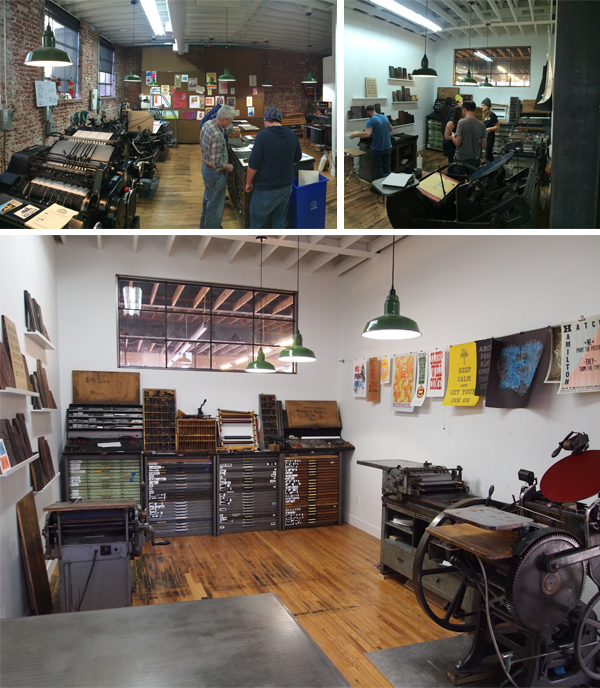
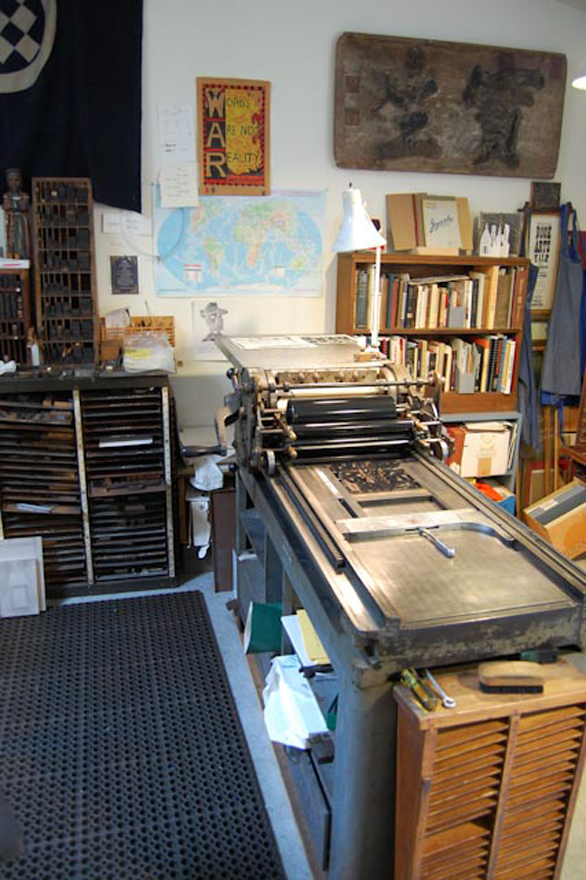
Nestled next to the hearty Mississippi River, Iowa’s own Slow Print hangs back in the thriving old Warehouse District in Dubuque and houses extraordinary letterpress work, a neatly arranged showcase of letterpresses spanning from a 1900s Chandler & Price to a 1960s 10×15 Heidelberg Windmill, and as many letterpress stories as there are ink cans. Peter Fraterdeus of Slow Print let’s us take a look at what’s inside.

Workspace Spotlight at the Slow Print letterpress shop in Dubuque

THE PRESSES: 1960s Original Heidelberg “Windmill” 10×15 – Red Ball, main workhorse production press; 1950s Original Heidelberg “Windmill” 10×15 – Black Ball, mostly die-cutting and fail-over; 1940s Vandercook 219 Proofer 19×26; 1930sMiehle Vertical V36 Cylinder 13×19.5, and a 1900s Chandler & Price Gordon Old-Style 10×15.

THE LOCATION: My shop is in Dubuque’s Historic Millwork district, a few blocks from the Mississippi River, and in fact, I’ve been one of the “flagship” tenants. In the past two years, a public-private partnership has upgraded the District, including all the streets & sidewalks and a full-block quadrangle building to the tune of well over $20 million. I just hope I don’t get gentrified out – but the arts are a primary core function of the newly active district.

I’m a block from the Voices Warehouse Gallery and a block from the new Dubuque Community Food Co-op, so it’s an exciting time to be in the area. The building is an early 20th century brick warehouse. The space I’m in was converted to offices many years ago, but it’s surrounded on the 1st floor by raw warehouse, currently inhabited by an ‘architectural salvage’ and antiques dealer.

FAVORITE THING ABOUT THE SHOP: My large blue oriental rug in the coffee/lounge area (about 100 years old, it’s nearly worn out) with the futon couch and 1960s LaPavoni espresso maker.

NUMBER OF PRINTERS IN THE SPACE: One, just me and my new apprentice for the summer, Rachel.

MOST VALUABLE SHOP TOOL: Other than the Heidelberg Red Ball, and my MacBook Pro (without which there would be no business!), the most valuable tool is my loupe.

PLATE AND BASE OF CHOICE: I use KF95 on a locally machined aluminum base. I bought a 24×48 slab of .875 aluminum and had it machined down and cut into numerous smaller sections from 18″x24″ (used on the Vandercook) down to 2″x3″. It’s been in use since about 2007.

FAVORITE INK:  Oil-based – either VanSon or others as needed.

SOLVENT OF CHOICE: WM Wash from LithCo. I use Putz Pomade on the rollers after wash-up, which keeps any remaining medium from drying into the surface. The slightly pumice gritty stuff also helps keep the rollers from glazing. I’ve been using rollers from Advance in Los Angeles with very, very good results.

OIL OF CHOICE: 30W non-detergent

FLOORING MATERIAL: Hardwood floors.

PIED TYPE: Plenty. Much of it is wood type, as I purchased a barrel full on ebay some years ago. Couldn’t stand to see it auctioned off a handful at a time. I have one galley full of 24 point Legend, the beautiful Ernst Schneidler calligraphic type, purchased from an eminent printer who was closing up his shop a few years ago.

He shipped the type in the cases, with nothing but a sheet of single-corrugated cardboard on top. When the shipment arrived, the UPS driver set it on its side (although it was marked “keep flat”) and all the type was pied in a mound under the wrapping. I was not at all happy. Took hours just to get it into the galley, and I still haven’t figured out how to read Legend backwards. Major headache.

ORGANIZATION ADVICE: High tables and work surfaces with plenty of storage underneath.

PRINTING ADVICE: These are hardly secrets, but for the auto-didacts who haven’t yet figured it out, these will help a lot.

  • Don’t add white to color. Add color to white.
  • There’s nothing worse than slimy long ink for sharp printing. But don’t add too much mag, or the ink won’t want to come off the roller!
  • There’s no point to adjusting the rollers if there’s too much ink on them.
  • How much is “Too Much” ink or “Too Long” ink is entirely dependent on the form being printed.

Deep impression only makes sense with deep paper, otherwise it’s just gauche. (Note to clients: you can’t have deep impression on both sides of the same sheet – unless there’s no overlap from back to front)

Slow Print Workspace spotlight

The Letterpress Roundtable, Part II: Letterpress love affairs

For our second letterpress roundtable discussion, we asked some printers we admire to tell us about their favorite press to print on (and don’t spare the details!). The stories are sweet, poetic, and inspiring. Read these responses and then we’d love to hear in the comments about your own love affair with a beloved press.

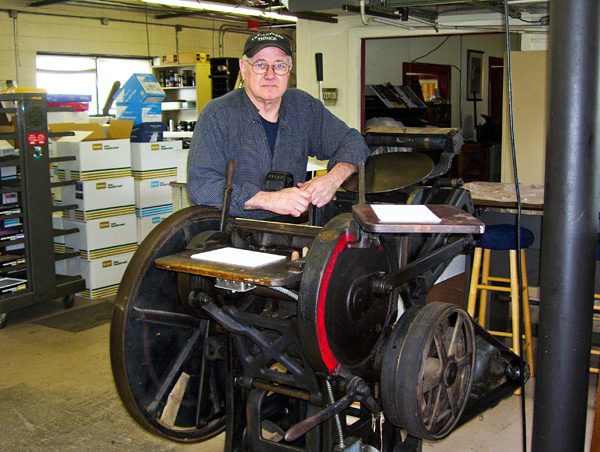
Todd Thyberg of Angel Bomb Design: My most widely used and favorite press at Angel Bomb is a Heidelberg Windmill which I’ve named Kaiser. I purchased it in 2009 from a printer who had advertised it for sale on Craigslist. I wasn’t on the lookout for a particular press, but I had been using a Chandler and Price for all my printing and wanted to be able to produce higher quantities of printing at a faster pace so I was keeping my eyes open for a good production press. Kaiser is a rock solid workhorse and a marvel of German engineering with an almost Rube Goldbergian sense of complexity. Kaiser had been relatively well taken care of but was filthy and several pounds of oil soaked paper needed to be removed from his innards before being used. His serial number is 104012E, placing his build date at 1954. He bears a badge stating “Made in the U.S. Zone of Germany” which reminds me of the Cold War era where spies lurked in dark corners and the world was a very different place. I use Kaiser to print small and large runs as well as die cut and he is always a hit with open studio events; the chug of the air pump powering the suction is like a siren song to passersby who get drawn in and are amazed at this old equipment that is still being used. Considering that this press was designed around the time of World War II and is still working today creates in me a sense of awe of how things used to be built and joy that I get to use him most every day.


Michael Russem of Kat Ran Press: I’ve recently retired from printing, but the best press I ever ran was my Vandercook Universal IV (SN 21497). It took a sheet measuring 32-7/8 wide by 29-1/2 tall—which was just about large enough for the books I was printing. Not only did it seem to be free of the usual problems that often plague power Vandercooks, but the enormous size of the cylinder and bearers cut down makeready time. Whereas I would spend tons of time making complicated tissue makereadies on my SP-20 and Universal I, there was just no need to do so on this big press. In fact, once I installed this Universal IV, I rarely used the two smaller presses as they weren’t worth the bother. And as the Universal IV was a power press, I was able to print twice as many forms per day without being exhausted and in pain when I crawled into bed. Of course, it took much longer to clean up the Universal IV, so I suppose the press wasn’t perfect. It was close, though. Now it’s with Art Larson at Horton Tank Graphics, and I hope Art finds the press to be as life-improving as I did.


Thomas Leech of Palace of the Governors Press: It was a tough call, but out of loyalty I have to say that my favorite press is my own 8×12 Chandler & Price Old Style that I’ve had since 1979. It’s not the best press I’ve ever run, but it is like a member of my family. The serial number is 26099, which according to the APA website puts its year of manufacture as 1890 – old enough to be my grandfather. It is driven by a leather belt and ancient motor that hums like a lullaby. Its comforting hum and rhythmic clanks put my kids to sleep when it lived below their bedroom.

I’ve owned it now for a quarter of its lifetime. I bought it from a guy who bought it from his brother-in-law, who bought it from a deaf man who printed cards with the American Sign Language alphabet. I still have a photoengraving of the manual hand signs, and printed it again only last year.

On November 23, 2008 the automatic counter, which I’ve never set back to zero, and which only counts to 99,999, turned over for the tenth time, which means that it had printed one million hand-fed impressions: business cards, book covers, birth announcements, wedding invitations, change of address notices, broadsides, poems, keepsakes, memorials, graduation announcements, wedding and baby shower invitations, clothing tags, bar mitzvah invitations, tickets, Christmas cards, Rosh Hashanah cards, art show invitations, book plates, keepsakes, and facsimiles.

While in my possession the press has printed under the names of The Fine Mess Press, the San Miguel Paper Workshop, the Smokebrush Press, and most recently, the Press at the Palace of the Governors. When a major building repair was required here at the Palace the press came back to my house, which felt something like having a grown child move back home. I regret I don’t have a photo to share of this press.


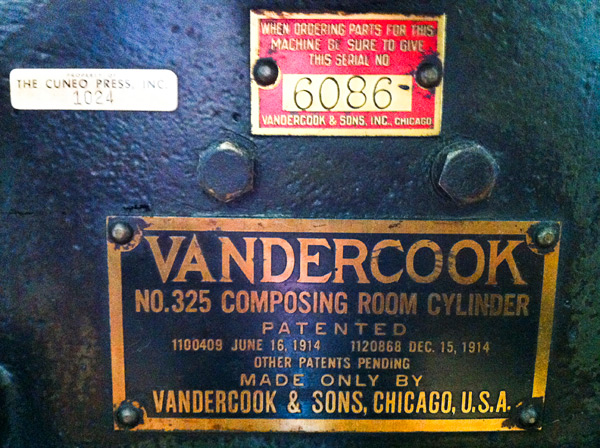
Eileen Madden of Evanston Print and Paper: That’s kind of like asking which of your children you like best. I’d have to say my favorite press to print on is the one I get to print on the least. Our big Vandercook 325 – serial number 6086. It’s my very first press. I bought it in 2007 from Columbia College. That’s where I learned to print, and I never saw anyone use it while it was there. It was mostly used as storage, I’m sorry to say. I guess I’d say it’s my favorite, because it’s the one I do projects of my own on – bigger posters or wood type collages. If I’m on that press it means I’m doing something just because I want to. As nice as it is to print with and for other people, it’s a treat to just play, too. After I acquired the press I found a metal tag on it indicating that it was owned at one time by the Cuneo Press – their press number 1024. The Cuneo Press was one of the large printing companies here in Chicago, and also had a fine book press that created some lovely and amazing work. Bill Anthony, who was a fine bookbinder who came out of the apprentice tradition in Ireland, worked at that press. I love having the connection with that history.

So. That’s my answer. In general I feel luck to be printing on any of our presses. I’m lucky to have this job, but I can say that the 325 is the one I’m the most personally pleased with.


John Barrett of Letterpress Things: The press that’s special to myself and the Barrett’s is B 57516, a new style C & P hand-fed with a Horton variable speed clutch. Manufactured circa 1920, Horace Moses purchased it in 1922 from an envelope company in Springfield, Massachusetts. Mr. Moses, a local philanthropist who founded Junior Achievement, Strathmore Paper Company and numerous other businesses, moved it to a building in Westfield, Massachusetts (formerly owned by the Westfield Whip Co.). There it was installed on the fourth floor as the first printing press owned and operated at Mr. Moses’ newest endeavor: The Old Colony Envelope Company. [The press still carries the original machine tag; a brass plate deep stamped with the number “1”.] It was removed from operations in 1967, about the time my interest in letterpress began to develop. Several years later, for the sum of $50, it was mine. Took it home and therein began my “second” career, Letterpress Services Co. From the beginning my interest was not so much in printing but in perfing, scoring, die cutting and imprinting; a trade service for offset printers, quick copy centers and in-plant printing departments. Old number 1 and me spent many, many hours together cranking out the impressions. Presently, “No. 1’ is semi-retired; eight Heidelberg Windmills carry the work load. But once in a while there’s a job best done by hand. And we step up, wipe the dust off, flip the on switch, coax the hand lever up to engage the clutch. And get goose bumps listening to the clack, clack, clack of the spliced leather belt. B 57516. . . ninety plus years and still pressing the letters.


Mark McMurray of Caliban Press: Well… my favorite press is really my first press, the one I bought with a deep breath, thinking: “in for a penny, in for a pound” after finishing just a week or two of letterpress classes at Red Ozier Press in lower Manhattan in 1985. It’s a 1947 Vandercook model 4T, serial number 10903, which is now tattooed over my heart. It came out of a commercial printer’s shop in New York that I was doing other business with at the time. Although it had been pushed to a corner and was not in use it had been well maintained over the years—which I’ve tried to continue. I remember my horror when suddenly one day one of the inking rollers started to wobble, then shock when I discovered that this was caused by a cracked bushing that was made out of wood (!), then relief to find that I could actually get a replacement (also wood) and fix it myself. (Thank you, Fritz, at NA Graphics).

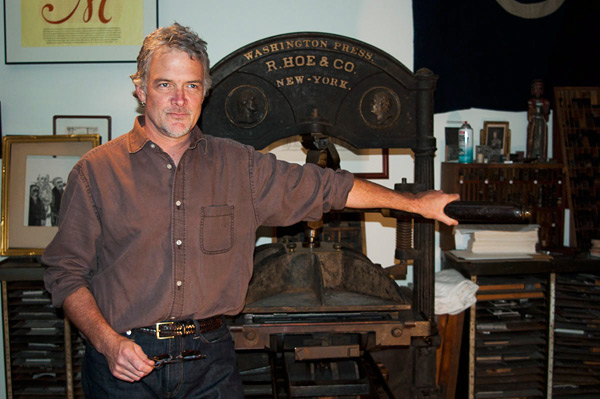
But my other favorite press (come on, life is too short for only one love) is a R. Hoe Washington. As I recall, Hoe began making these in the early 1830’s when he somewhat unscrupulously appropriated the famous “figure 4” toggle joint from another manufacturer. Most of the Washingtons that I’ve come across have had serial numbers cast on them. Mine does not. Therefore I’m assuming it’s early in their production cycle and I date it somewhere around 1835. I suspect press historians may have some views on this matter. I acquired mine from the late wood engraver Frank C. Eckmair who got it not far from his home in Gilbertsville, New York. A local Northern New York printer, Jim Benvenuto, helped me set it up and adjust the platen height and I’m always surprised at how well it prints, given its age and technology. So there… my two favorite presses.


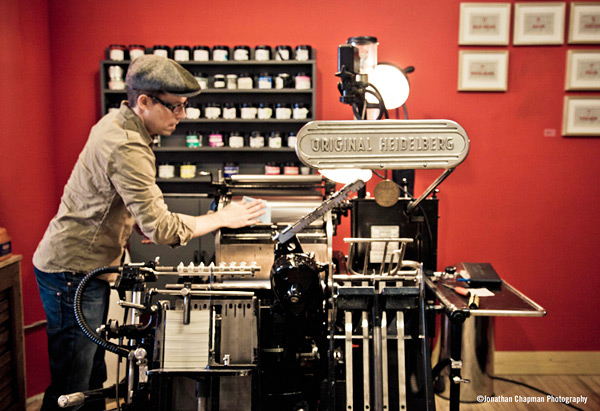
Brooks Chambers of Mamas Sauce: My main squeeze is an Original Heidelberg. Serial # 49582.
We adopted our Windmill from her original owner a couple of years ago. “Heidi,” as we’ve come to call her, was the workhorse of a family-owned basement print shop in Buffalo from the day she rolled off the line. We found her lovingly entombed with a host of tools, spare parts, and other presses that had been with Heidi since day one. The whole gang came with us to Orlando (no toy gets left behind) and Heidi still sits at the heart of this menagerie. Every time we give a tour, people react to her the same way that I did at our first meeting: they stop, stare, and smile. At that point in the tour, I’ve learned to shut up and get out of the way.

She isn’t the first Windmill I’ve had the pleasure of running, but she’s the best. If I had to put words to it, I’d say she’s delightfully invisible. She’s invisible in the way that every good interpreter ought to be. Other presses often interject, leaving the marks of their own idiosyncrasies throughout the run (even if their operator is the only one who knows). Heidi does exactly what I ask her to. Every. Single. Time. That kind of control gives you the freedom to defer to the artwork for inspiration. That kind of control forces you to become a better printer. Before we got Heidi, I could blame a lot my shortcomings on the press. Not anymore. Now the press gets all the blame for my success. She’s teaching me a lot about knowing when to shut up and get out of the way.


Brad Ewing of Marginal EditionsMy favorite press is the  Vandercook Uni III.  It has an adjustable bed and its rollers are super dialed in!! The serial number is #26318.  It’s currently located on 6th avenue and 29th street in Manhattan.

Leslie Miller from Grenfell Press told me that the press came from Middletown, New York about 20-25 years ago. It was large enough that it was taken apart and brought up to the 7th floor by placing the press on top of the elevator.

I have been printing lead and polymer plates on the press since 2005. I have also printed laser cut plexi, etched copper plates, leather, and even potatoes on this press. The ink splatters that have built up over the years on my Vandercook serve as a happy reminder of many beautiful print projects accumulated.


Is it any surprise that we love our presses? All of these presses have earned our love and loyalty and even a name or two. Now it’s your turn to tell us about the one that grabbed your heart and makes you a better printer. If you’ve got photos online of your press and you’d like to share them, please include a link to the photos in your comment!

Jack & the Beanstalk

Actually it’s Joe and bamboo that grows in Pat’s magic Heidelberg windmill. We’re waiting to see if Joe climbs it.

Bill is also becoming a press farmer with a strong daffodil that’s growing like crazy!

Running Windmill

The sleep machine is running, unaware it is being watched. Long out of production, this Heidelberg 10 x 15 windmill letterpress still runs smoothly & precisely with the loving care it has been given over the decades. If you listen closely, you can hear it breathing & purring as ink is pressed to downy white cotton paper.

Glorious Windmills

In a gleaming array of fine machinery, here stand some of our prized workhorses, Heidelberg 10 x 15 Red Ball Windmills!
heidelberg windmills in a letterpress print shop

Ink Blooming

One of my favorite parts of printing is watching fresh ink bloom on the rollers. Royal blue comes up nicely. Yes, to the printers out there, I did tighten up the rider roller. Laypersons that’s the silver one on top that carries extra ink and didn’t ink up like everything else.

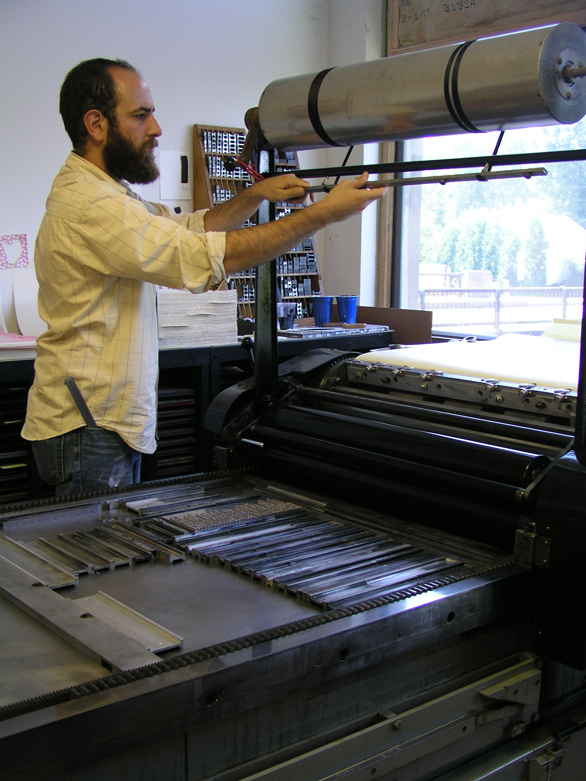
Dave is running the Heidelberg KSBS cylinder press

Much like a lion-tamer, Dave persuades the press to do fancy tricks: match Pantone, don’t feed too fast, get the right amount of air flowing.
Heidelberg KSBS letterpress printingHeidelberg KSBS letterpress printer

Paper Feeding

See how far the top of the paper stack is away from the holes and springy fingers? That’s a good space for smooth sheet feeding. Keep the stack rising at this constant rate depending on paper thickness, amount of air blast, angle of suckers and where air blast fluffs up the stack and you’re in business as a smooth operator.

letterpress printing paper feeding

Field trip to Platemaking

Greg peels a plate off the washout unit on the platemaker. In the water are brushes that have taken off non-inking areas of the plate.

platemaking processplatemaking at the momentletterpress plates being made