Flying High With Two Crow Press

Image

Beneath the expanse of the blue skies and huddled next to the wheat & sunflower patches of Kansas, holds Two Crow Press. A Kansas born and raised Ashley Flinn meticulously threads her unique triple-play passions of bookmaking, papermaking and letterpress within Two Crow Press’s shop space. Ever one to experiment with the boundaries of printing & the love of paper, Ashley spent some time catching us up on the whimsical new “unromantic” Valentine’s Day cards and being featured into the finals for Kansas State University’s “Next Big Thing” Contest (to which she’s taken the Gold). Two Crow Press sat down with Boxcar Press for an interview about their latest work

BIG PRESS ON THE PRAIRIE I’ve lived in Kansas for 25 years. I was raised in Manhattan, KS, attended  classes at K-State, and got my BFA in Printmaking from the University of Kansas in Lawrence. In 2010, after graduating, I moved back to Manhattan and married my long-time boyfriend at a kick-ass wedding on the prairie. I’ve been taking graphic design and business classes at K-State and I started my own letterpress and graphic design studio last  March. My first job was printing wedding invitations for friends from New Jersey.

LOVE AT FIRST SIGHT At K-State there was a very talented book artist, Rachel Melis, and I had her for 2D Design. She was a great teacher, so I kept taking her classes. The next class I had with her was a summer class in book arts and letterpress. Before then, I had just been a photographer, but when I saw what letterpress could do and that you could make books by hand I was floored. It was amazing. Luckily, when I transferred to KU another teacher, Linda Sampson-Talleur, offered classes in those subjects AND papermaking. Basically if it involves paper, is process oriented, and needs a ton of paraphernalia, I’m into it. KU has a great letterpress studio and type collection, including 3 Vandercooks! I miss the shop there a lot. So much space.

SPECTACULAR IN THE SUNFLOWER STATE My print shop is in my basement studio. On one wall, I have a drying rack next to my press. I keep all my inks and supplies under the press table. Next to that is my binding and folding station on a low table in the corner. The rest of the studio is drawers of supplies and paper.

THE CREATIVE PROCESS My designs can start in a number of ways. Usually it’s an idea or theme I want to work with like “un-romantic” Valentine’s cards, neurotransmitters, or evolution calling cards (for when you really don’t want to explain for the nth time why monkeys don’t give birth to humans or “gaps” in the fossil record). Other times it’s just playing with type. One of the best things about designing on a computer is the amazing variety of forms we have access to. Though as a printmaker, I do love working within the limitations of a craft (I’m thinking about you, intaglio…), if I had room for physical type, I’d love playing with that just as much.

Two Crow Press is a letterpress print shop based in Kansas

PART TIME PRINTING I don’t print full-time. My day job is being a computer lab aide at the local high school. My days are literally non-stop troubleshooting. My ultimate  goal is to open a maker space with my husband that will have letterpress, screenprinting, intaglio and relief presses, papermaking, bookbinding, metalsmithing, and all kinds of tech things he’s involved in like 3D printing, a laser cutter, a CNC router, etc. with a shop and gallery attached. I’m really into educating people about various art forms and technology, but I also love creating objects (be it stationery, copper vessels, or limited edition prints). Also my husband wants to experiment with integrating letterpress with the things he knows, and try things like making wood type with a CNC router, etc. and we’re starting to form a sister brand to Two Crow Press for our collaborative work that will be a little edgier and darker (death metal Easter cards, etc.).

PRINTING FEATS Hand watercoloring autumn leaves for 100 wedding invitations for my friends. I felt like a badass. I never push my paper farther than it can go. I understand the desire for a deep impression, but I refuse to punch the paper to the point there’s a big indentation on the other side. If someone wants a deep impression, I use thick paper. I always print my paper damp as well (thank you Linda!) As for material accomplishments, I’m pretty new to the game, so no killer accolades yet. I have been doing pretty well with Etsy sales though, so things are shaping up nicely. Two Crow Press is a letterpress print shop based in Kansas

PRESS HISTORY My first (and currently only) press is a New Style Chandler and Price Pilot. I’ve had the pleasure of working on a Vandercook Universal I, but at the moment don’t have the space for a big press like that.

BOXCAR’S ROLE Without Boxcar Press, I don’t think my business would be sustainable. The ease and affordability of  ordering plates through you guys is unrivaled. That less than 90 sq. in. equals 2 Day Free Shipping deal is AWESOME. Your website is also very nicely designed. Not to mention the recycling of plates gives me one more green selling/bragging point (and it’s just the right thing to do). Two Crow Press is a letterpress print shop based in Kansas

SHOP TIPS Try printing with damp paper at least once. Also try printing on many different papers. I started printing on printmaking papers (Somerset Velvet and Rives BFK) because that was what I was most familiar with, and then branched out to other papers. They all have very different qualities, and it’s good to experiment to find the ones you like best for certain projects.

WHAT’S NEXT This year, I’m hoping to have more time to dedicate to printing. I’m planning on increasing the amount and variety of things I print, and adding a part-time intern to my payroll. I’m really hoping to  collaborate with a few local artists to produce limited-edition letterpress art prints. Maybe 3 color and 7” x 10” prints (that’s about the max my press can handle). I’m also going to try letterpress printing paper that has been chine-colléd, some delicate washi attached to Lettra might be really awesome.

Big heaps of thanks out to Ashley for letting us take a look at Two Crow Press!

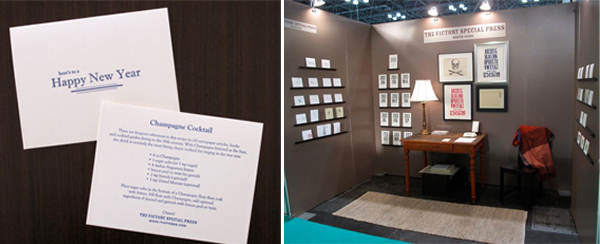
The Triumphs Behind The Victory Special Press

The Victory Special Press is run by Emily Harris: Nebraska born, Boston raised, and Alaskan forever. Her Anchorage-based press finds its creativity from passions that combine paper-making, letterpress, vintage finds, and of course, the incurable itch to create more. We caught up with Emily to catch the secrets behind The Victory Special Press.

The Victory Special Press is a letterpress print shop based in Anchorage, Alaska

NORTH AMERICAN PRINTING TREK The Victory Special Press is based in Anchorage, Alaska. We moved up here in the summer of 2012, and it’s been an amazing experience for me personally and for my design aesthetic.

I’m originally from Nebraska, spent about eight years living in Boston, and lived abroad a couple of times. I’m definitely eclectic and enjoy exploring different places and cultures (hence all the moving around). We came up to Alaska on holiday last winter, totally loved it, and decided we wanted to make Alaska our new home. Within a few months we had crated the presses, packed up the car and headed north. The drive lasted about six weeks, spanning the continent from Boston to Anchorage: about 9,000 miles. We took a circuitous route and visited many friends and family along the way. I also emailed letterpress printers in some of the towns we stopped in, so we got to meet some amazing people and see some cool shops throughout the US and Canada (thanks to all for opening your print shop doors!). It was really great to continue the letterpress dialogue as we traveled. The highlight was meeting Fritz Klinke and finding the original card of sale for my Vandercook 3 (thanks, Fritz!).

FOR THE LOVE OF LETTERPRESS When I was living in Boston, I woke up one morning with a strong desire to make my own paper. I took a really great week-long intensive class, then ended up with a bunch of paper that I wasn’t sure what to do with. A community print shop offered letterpress classes, so I enrolled in a beginners series and printed solely on my handmade paper. The class was so fun; I totally fell in love with letterpress printing. From there I became a member of the print shop and printed on their Vandercook 4, honing my skills. About a year after I began printing, I got my own Vandercook 3 and started up my company!

Victory Special Press is a letterpress shop based in Anchorage Alaska

I still print on my handmade paper from time to time, but for most jobs I stick strictly to commercial papers. However, there’s something very calming about pulling sheets from water, so I’m hoping at some point to have a section of my studio built out for papermaking.

LETTERPRESS IN THE LAST FRONTIER STATE Since we moved not that long ago, the print shop is currently in the garage. I actually quite like it – when the weather is nice I leave the garage door open so I get lots of fresh air, and the occasional curious moose that walks by! It’s also been a great way to meet the neighbors – everyone seems to have a fascination when the presses are running.

Victory Special Press is a letterpress print shop based in Anchorage Alaska

We transformed one of the extra bedrooms in the house into my studio space, so I have plenty of room to spread out. I also like being able to keep finished product far away from the presses – there’s a “clean” room and a “dirty” room.

Victory Special Press is a letterpress shop based in Anchorage Alaska

THE CREATIVE PROCESS I’m both a designer and printer, and have been printing full time for about two years. Because of my Nebraska roots and now living in Alaska, I’m totally fascinated by western, old-timey imagery and images from the Gold Rush in Alaska and the Yukon. I like to flip through books of antique cuts from the 19th century or find vintage photos, postcards, etc. on the internet or at the library. The Anchorage Museum has had some exhibitions recently of etchings from some of the first trappers in Alaska, and photos from the Gold Rush that I spent a lot of time looking at. I use all of that research as inspiration, then sketch ideas out by hand. I then translate the design to the computer by redrawing in Illustrator.

PRINTING FEATS Last year was our first year at the National Stationery Show trade show in New York City. We met some key buyers during the show, and then a large order developed in the weeks after the show, which was during our cross-country trek. We would have to optimize times when we had a WiFi connection (or at least some sort of cell service) so I could read and respond to emails. Because of the store’s deadlines for the holiday season, by the time we got to Anchorage we didn’t have much time to print, package and send off the product. I’m really proud of the fact that, while it was stressful at times, it didn’t stop me from enjoying our trip and experiencing all the beauty our drive had to offer, and that I was able to turn the order around so fast once I got the press uncrated!

BOXCAR’S ROLE Boxcar has helped in a myriad of ways: as a resource for supplies when I got my first press, tips and tricks from the blog, an easy-to-use base with a grid that makes registration much easier. But perhaps most importantly, Boxcar doesn’t care where I live.

When I moved to Alaska, I had to change a lot of my suppliers because the shipping charges were more than the cost of the product. Boxcar has a flat rate for shipping their plates and it’s allowed me to continue to have high quality plates that my product depends on, while not breaking my business’s bank.

Victory Special Press is a letterpress shop based in Anchorage Alaska

SHOP TIPS Don’t forget to keep a playful mind when printing. Since I’m somewhat self-taught, I often think, “What would happen if I do this?” And I try it. Sometimes it doesn’t work, but sometimes it does work, and it can make the print even better than I expected.

Victory Special Press is a letterpress print shop based in Anchorage, Alaska

WHAT’S NEXT We’ll be going back for our second year at the National Stationery Show in New York this May. If you’re there, swing by Booth #2262 and say hi!

Big round of thanks out to Emily Harris, the clever letterpress printer behind The Victory Special Press!

The Crisp Impressions of Freshly Squeezed

Gracie Fenech of Freshly Squeezed opened the door to her Grand Rapids, Michigan-based letterpress haven and toured us through her cozy shop, which overflows with laughter, the clacking of her beloved C&P, and of course, fond memories of ink meeting paper.

Gracie Fenech of Freshly Squeezed gave Boxcar Press a tour inside her Grand Rapids, Michigan letterpress shop

Photography courtesy of James and Katie Photography.

THE PRESSES Currently, my only press is a century old Chandler and Price 10×15 new style platen press.

SIZE OF PRINT SHOP My section of the shop is about a tenth of the total work space with about 250 square feet.

TYPE OF SHOP I share a work space with a screen printer, which has been a great relationship.

THE LOCATION My shop is located in an old factory building that has been repurposed and now holds a variety of different businesses, both large and small.  There are several antique stores just around the corner which I love to visit before I go to work.

FAVORITE THING ABOUT THE SHOP One of my favorite things about the shop is my old wooden work bench. It was given to me by a friend’s father who got it from his father. It had been in his woodworking shop for ages and is covered with years of paint, scratches and spills. There is a metal plaque on the side that says “The United States of America Flying Boat Division”.  I can only imagine what sort of history is there!

NUMBER OF PRINTERS IN SPACE I share work space with a screenprinting shop (Hillhouse Screenprinters) which has been a really great relationship so far. Screenprinting and letterpress printing have a lot in common so we are able to learn from each other.

MOST VALUABLE SHOP TOOL My most valuable tool in my print shop is oddly enough my little rubber thimble. I use it all the time for various tasks and it keeps my finger clean from ink which saves me a lot of time washing my hands!

INK OF CHOICE I generally use VanSon’s rubber based ink, but for specialty ink colors (metallic and fluorescent) I use Ink in Tubes oil based ink. Both are great, but they have their differences. My current favorite color of choice is a soft mint like Pantone 621. I think this color looks great on the Crane Lettra in Pearl. It creates a beautiful vintage feeling.

SOLVENT OF CHOICE My method for cleaning has been to keep the rollers on the press and use a shop rag dipped in California Wash. I just roll the press slowly back and forth until the rollers are clean. Then I clean the ink plate and go over everything once more with a clean rag.

PLATE AND BASE OF CHOICE I have been using a 9×12″ Boxcar Deep Relief base since last year.

OIL OF CHOICE I use a white motor oil for my press and it works like a charm!

WHAT TYPE OF RAGS DO YOU CLEAN UP YOUR PRESSES WITH I use blue shop towels for clean up.  I like them because they are durable enough to use multiple times.

FLOORING MATERIAL I don’t even know what our floor is made out of to be honest!  I’m sure it’s some sort of industrial linoleum.

FLOOR PLAN TIPS The best floor plan is one that creates a work triangle. I have my paper cutter, work bench and press all within reach of each other. This way, I’m not wasting as much time running across the room.

PIED TYPE Honestly, I don’t recognize this term.  I feel like I still have a lot of letterpress lingo to learn.  I have a large type cabinet with various fonts…century gothic is my favorite.

ORGANIZATION ADVICE I don’t think this would be considered a secret, but I have found that keeping a clean shop is by far the biggest way I boost my productivity. I’m distracted by too much unnecessary clutter.

PRINTING ADVICE When I first started printing, I couldn’t figure out why my printing wasn’t crisp. Everything seemed to have a blur around the edges and bleed into the paper.  After countless hours of trial and error, I realized that I was using way too much ink.  I backed way off and my next print was nearly perfect.  What a relief!  I realized that learning to listen to your press to find the right tuning is such a huge part of what makes a great printer.

Freshly Squeezed is a letterpress print shop based in Grand Rapids, Michigan Freshly Squeezed is a letterpress print shop based in Grand Rapids, Michigan

Taking the Plunge Into Letterpress

Curious about what it takes to make the transition from letterpress printing as a hobby to a career? We chatted with some inspiring printers who have made the leap from hobby printing to either full or part time printing. For some, the plunge was just natural; it came to them the first time they ran the press, for others, the story is a serendipitous chance of events. We gathered some of letterpress’s best to give their testaments to the alluring power of printing. Read their stirring stories and then we’d love to hear in the comments section about what it was that made you want to take the full plunge into the world of letterpress!

Cara Matocha – Im-press-ive Letterpress

To be perfectly honest, when I first got into letterpress, it was on a whim. I am a graphic designer and have owned a boutique design firm since 2003. Chris (my husband) is a project manager at a software company. We both thrive on creativity which leaves us short on time and too many expensive hobbies.

Boxcar Press spoke with a group of inspiring printers to find out how they made the transition from hobby to career when it comes to letterpress printing

In 2010 I planned a family trip to Santa Cruz for the week. Other than going to the Monterey Bay Aquarium we made no other plans for our trip. On the way to the airport we were brainstorming ideas for a new business that Chris could do on the side; something creative that he could make his own and be profitable at the same time (as a way to balance these expensive hobbies). I threw out the idea of letterpressing. A friend of mine had recently purchased a table-top press and I was very interested in the process. Chris instantly loved the idea, so we hashed out the details over the course of our Santa Cruz trip and upon our return we began searching for a table-top press.

We ended up purchasing a C&P Pilot Press in July of 2010. The press arrived refurbished in November of that year. We knew very little about printing, but Chris tirelessly researched the ins and outs of printing so it took him no time at all to realize we needed to contact Boxcar for a base among other things.

By February of the following year we had our website up and were getting letterpress inquiries. It only took us 2 or three jobs to realize that we loved the process AND we needed a bigger press!

Boxcar Press spoke with a group of inspiring printers to find out how they made the transition from hobby to career when it comes to letterpress printing

We came in contact with a wonderful man in Oklahoma who sold us our C&P 8×12 old-style press in August of 2011. Little did we know we would be making the trip two more times to pick up a Heidelberg Windmill 10×15 and eventually a 14.5×22 C&P!

Once we had 2-3 jobs under our belt we were hooked, but I will admit we were VERY nervous each time a new job came in. There was a big learning curve to printing beautifully: from packing, to platemaking, inking as well as learning the quirks of each press. It was a bit daunting, but we knew we had to continue taking on the work so we could become more comfortable with the process. Our part-time shop grew very quickly, at times it was too busy! I learned to dial back the marketing slightly so that we could maintain a comfortable stream of business. Chris and I enjoy our day jobs, so we are happy with our part-time status. Do we hope to go full-time in the future? Absolutely, but for the time being we are happy with things as they are.

Boxcar Press spoke with a group of inspiring printers to find out how they made the transition from hobby to career when it comes to letterpress printing

Danielle Bliss – Wishbone Letterpress

We started Wishbone Letterpress because I lost my job, and was unable to find a decent paying job. I had been commuting to NYC from the Hudson Valley, and we didn’t want to move to the city, and I was exhausted from commuting for 5 years.

Boxcar Press spoke with a group of inspiring printers to find out how they made the transition from hobby to career when it comes to letterpress printing

Boxcar Press spoke with a group of inspiring printers to find out how they made the transition from hobby to career when it comes to letterpress printing

My husband still has a full-time job, and he helps me at night and on weekends. But I started Wishbone Letterpress full-time right from the beginning. I was laid off from my job doing design and animation for a national morning television show. We were taking letterpress classes and researching business development while I was still working, but hadn’t planned on starting a letterpress business so soon. Local jobs were scarce so we figured it would be best to start our own business. After the first class that we took at the Center for Book Arts we fell in love with the process, so it was an easy decision.

Sharon Braun Hutton – Letterpress of Tulsa

I think letterpress found me more than I went looking for it. I had learned some of the most complex motion graphic programs with a career in Los Angeles working at Geffen Records and then developing the DVD for MGM assembling over 5000 DVD’s including the James Bond collection but I missed something. I’m what I call a “designosaur” a graphic artist from pre-1985 before the Mac was introduced – someone who used T-squares, triangles and wax machines. I missed using my hands and having skills that everyone with a computer didn’t think they could do. I missed the days when most people didn’t know what Helvetica meant. Being part of the letterpress community now I feel like a true craftsman again. Every time I pull out my pica pole or tweezers that I’ve owned for 25 years, I get a sense of accomplishment and nostalgia that hitting the print button on the keyboard couldn’t do.

Boxcar Press spoke with a group of inspiring printers to find out how they made the transition from hobby to career when it comes to letterpress printing

Boxcar Press spoke with a group of inspiring printers to find out how they made the transition from hobby to career when it comes to letterpress printing

David Armstrong – Sevanti Press

There are two major aspects of a business: producing goods, and selling them. In the context of letterpress, producing is the fun part―printing is why we got involved in the first place. Actually turning what we have made into a living can be an entirely different matter. One danger is to minimize the importance of this second aspect of business: ‘When they see my beautiful work, it will sell!’, or ‘I can sell online―the world is my market!’ However, the world―and especially the internet―is a noisy place, and it is hard to be noticed at all, let alone make an impact.

One of the top marketing minds in the world, Terry O’Reilly, recently pointed out that some of the most successful brands have become that way by focusing, not on what they sell, but why they are in business. And in letterpress―where anyone with a computer can order a plate and crank out thousands of great-looking impressions―the “why” is vital. Ask yourself “why do I print?”, “What makes what I do different from everyone else?”

Boxcar Press spoke with a group of inspiring printers to find out how they made the transition from hobby to career when it comes to letterpress printing

In the case of Sevanti Letterpress, our “why” grew out of an already-established business: vintage fountain pens. My wife, Michele, had purchased a fairly expensive greeting card for a friend with her usual care and thoughtfulness. But when it came time to write the message, she was disgusted to see the ink from her favorite fountain pen (a Parker “51”, which writes with a relatively dry line) bleed through the paper, ruining it.  The ensuing conversation, edited for family viewing, went something like: ‘If only there could be a line of high-quality, classically-designed cards, guaranteed to be fountain pen-friendly. Wait a minute! If you want something done right, do it yourself!’ And a major part of our “why” was born.

The other facet of our “why” stems from our love of classic typography and design. No funky angled printing, multiple colors, or 1950s clip art here! All of our printing is done with movable type, and with original cuts; white space rules. Every card has an enclosure explaining the origin of the graphic and, whenever possible, the location it can be found in century-old specimen books. While this limits us to some extent, it also appeals to an enduring, and literally ancient, aesthetic. And it marks us as different.

Once you have a “why”, trumpet it everywhere. In your logo, on your website, in your email signature line, on the back of everything you print. Having that “why” will make you stand out, and will also be a constant reminder of what makes you different, and better, than everyone else. And in a noisy world, that will go a long way towards being noticed.

Of course, this all takes time to accomplish. Many years ago an experienced entrepreneurial friend of mine told me that, when starting a business, “don’t expect to make any money for at least two years. And even then you will be working like a dog, but at least you won’t be broke.” So don’t quit your day job.

It may be tempting to lease out the shop space of your dreams, surround yourself with type cases and presses, and revel in the printing life. But remember, dream shops like you see in online photo galleries have taken lifetimes to build up, and at great cost. If you can sell what you print out of your living room―or in our case, off the dining room table―then do it. If you go into debt to start up, then you don’t really own the business, your bank does. If you expand when you can afford it, and only as much as is safe, then the result will be a stable and established business, wholly owned and controlled by you.

Printing doesn’t require a huge infrastructure, and if you keep your eyes open you might pick up equipment for a song. Shortly after finding our press, I struck up a conversation with a “living history” exhibitor at a local museum. “You should talk to our registrar,” he enthusiastically stated. “The basement of one of our buildings is full of donated printing gear we can’t use, because it is out of our date range!” Several sweaty afternoons later, and after a donation of some nice writing boxes and implements that were in the appropriate date range, we had a small printing shop full of type, furniture, and the paraphernalia needed to print anything our hearts desired. So ask around. Attend the local wayzgooze. Make friends with printers. You never know with whom you can trade equitable favors. The details of what you print, and how and to whom you sell, will vary depending on your location, your market, and your circumstances. But the founding principles―the “why,” and the financing― are what will make a big difference between a zealous hobbyist and a lasting professional.

Sarah Almond – Shed Letterpress

I still distinctly remember the night after my first letterpress class at the Center for Book Arts in New York City. I met my husband for drinks nearby and declared, “Oh man, I’ve finally found the thing that I want to do!” It really was like a light had been turned on in my life, and everything was suddenly illuminated. I loved the meditative process of setting type, as well as the historical anecdotes our instructor, Barbara Henry, told as we worked. The smell and patina of the lead on my fingers reminded me of days spent in my grandfather’s shop as a child, and the presses…well, the presses completely fascinated me. What I loved best, though, was the sense of accomplishment that I felt after pulling a print—the instant gratification of it, combined with the knowledge that every impression was slightly different. I felt humbled and elated by the process.

Sarah Almond of Shed Letterpress with one of her presses

I think I knew, even at that early moment, that I would end up as a printer. I was lucky enough to land an apprenticeship in the garment district at a commercial shop, where I quickly learned the difference between futzing around with type and making sure that stationery for Versace and the New York City Ballet looked its absolute best. What surprised me, though, was that I loved all of it. For me, the art was in the process, not the end result. It didn’t matter if I was printing for myself or the fanciest society soiree; when I was printing, I was happy. Almost immediately I started thinking of how to make letterpress my full time job.

Boxcar Press spoke with a group of inspiring printers to find out how they made the transition from hobby to career when it comes to letterpress printing

There were many schemes that were tried and discarded, including working as an under-the-table Windmill pressman at a large commercial print shop on the docks in Red Hook, Brooklyn. The press was in terrible shape and most of my work consisted of die-cutting and numbering, which I hated. Through these piecemeal jobs, I was learning that what I wanted to do was all of it. I wanted to design beautiful things and print them, too. Maybe it’s because I learned on a Windmill, a more traditionally commercial press, but it never occurred to me to just get a C&P and make some stuff in my spare time. I went from working for someone else to dreaming of my own Windmill, and my own press.

My husband and I began to toss around potential names. We had already planned to leave NYC, but hadn’t yet set a date. I scoured Briar Press looking for a Windmill to call my own, but everything was still very hazy and dreamy at this point, an idea but not an actualized one.

On our first wedding anniversary, all of that changed. I’d decided on the name Shed Letterpress for my business about a month before, and my husband surprised me with my very own letterpressed business cards as my paper gift. He had designed them and had them printed by my former mentor, Tim Chapman of Press New York. For whatever reason, the cards made everything very real. I bought a Windmill in Pennsylvania within the month and, since there was no place to put it in our third floor walkup, we picked up speed with the move out of the city. I quit my job and, four months later, we found ourselves in North Carolina and Shed Letterpress was born.

The original Shed was hastily picked more for its convenience than its appeal. It was a flex space in a storage facility that one of my clients described as “kind of sketchy.” For the first year back in NC, I printed when I could while working other odd jobs and getting settled in my new city, but I knew that I had to find a better spot.

The decision to go full-time with Shed Letterpress was really just a matter of finding the right space. Once I found my current studio, in the heart of downtown Durham with a wall of windows, I knew that I owed it to myself to give Shed Letterpress everything I had. It was actually scarier, to me, not  to go ahead and do it! My husband, as always, was incredibly supportive of my venture and agreed to float me for a while until I had things figured out. In hindsight, I had absolutely no idea what I was doing, and am still having “duh” moments every day, but I wouldn’t trade the experience for the world. Ultimately, what made the decision easy for me was the unwavering support of family, friends, and letterpress colleagues that I’ve met along the way. Knowing that there was always someone on the other end of the phone, or even just asking the same question as me in a Briar Press post, made me feel less alone and more able to take on the crazy responsibility of becoming a small business owner. I’m three years in now, and going strong!

Amy Rau – Green Girl Press

I was looking for a creative outlet to provide an escape after my corporate workday. Initially, I had been searching for a calligraphy class – something I could practice at home without designating a ton of space. But alas, calligraphy was not being offered that session so I enrolled in another class – Intro to Typography, a beginners letterpress course. Our first project was to sort a bunch of type into a California Job case. I was instantly smitten.

I knew really early on that I would be growing a business out of my passion for letterpress. The story goes: within 10 minutes of my first letterpress class at the Genesee Center for Arts and Education, I had fallen in love. By the end of the second class, I was dreaming if quitting my day job. 6 months later, I did. For me, the excitement is in the creation. I knew I would have to sell my work in order to pay for more creation. And I was OK with that because I was producing far more than I could ever keep!

Boxcar Press spoke with a group of inspiring printers to find out how they made the transition from hobby to career when it comes to letterpress printing

As with every successful letterpress project, start from the end and work backwards. Make a business plan. Ask yourself, where do you want to end up? Then list out the steps you need to take in order to achieve your goal. It doesn’t have to be a super detailed, even just a short list outlining your goals and expectations can be really helpful. Defining what you want your business to become is the best way to manifest your goal. And as a bonus, you sound smart and confident when you talk to people about your new business because you’ve taken the time to establish a foundation.

Misako Rothery

My transition from hobby printer to full-time printer happened about two years ago but it was about ten years in the making. I took my first printing classes as an undergraduate student, continued dabbling throughout graduate school, and then took my first letterpress printing course at The Center for Book Arts (NYC) in 2010.

Letterpress printing examples by Misako Rothery

I knew I wanted to do letterpress full-time when I realized two things: how happy doing it made me feel, and how happy a custom piece of stationery made my clients feel. Taking the plunge, for me, involved an uncomfortable balance of desire and uncertainty, but it was a willingness to challenge myself that ultimately set me in motion.  Having studied environmental design, then landscape architecture, I used that formal education to develop my first projects. I still try to incorporate artwork involving architectural elevations or place mapping whenever appropriate.  And of course, as a print maker, the precision skills do come in handy.

For what it’s worth, I think that when transitioning into anything new, it’s helpful to see everything you’ve done as building blocks for your future.

Patrick Masterson

In my case, clarification came in an unambiguous and unwelcome form—I was laid off from my job in February 2009 as the economy was tanking. I had been running a small letterpress shop for a design firm in Birmingham, Alabama whose main clients were a large regional bank and various real estate developments. Not the best clients to have at that time.

Boxcar Press spoke with a group of inspiring printers to find out how they made the transition from hobby to career when it comes to letterpress printing

Had I not been laid off from my job, I’m not sure if I would have ever gone out on my own. Health insurance and a steady, decent paycheck are difficult things to turn one’s back on. Fortunately (or unfortunately), all I know how to do is run a letterpress so it made the next step undeniable. I looked for the cheapest space available, which was a dingy storefront that needed a ton of work but only cost $350 a month. I spent six weeks making it into a habitable printshop and had $6000 to my name at the end of it. I figured I could last 3 or 4 months without earning a dime, longer if I slept on the printshop floor. Business came slowly at first but I made enough to get by and keep the doors open. Word of mouth does wonders. I am now entering into my fifth year of business and am grateful every day for my good fortune.

Taylor Valliant – Noteworthy Paper

I am a true believer of serendipity; I think things happen for a reason, that if you’re listening, your life’s work is calling out to you like a soul mate. Print work has been following me around for most of my life. As a child I would regularly skip school so I could go to art school with my mom, who was attending the Museum of Fine Art school in Boston and later received a Masters in Printmaking from Tufts. Her studio was my happy place… I was always enamored by the smell of print: fresh sawdust in the wood shop where plywood became relief, the earthy smell of ink mixed and spread, turpentine in the air everywhere.

Boxcar Press spoke with a group of inspiring printers to find out how they made the transition from hobby to career when it comes to letterpress printing

(photograph courtesy of Green Door Photography)

I went off to college for creative writing and back again for graphic design. And after struggling to find my place in the graphic arts world, I worked for a newspaper and a great little magazine called MaryJanesFarm, where I was exposed daily to the cast iron trappings of a bygone era. During that time, I got engaged and discovered letterpress printing. I hand illustrated my wedding invitations and had them printed in Provo, Utah by Bryce at Bjorn Press, who was incredibly generous with his time and knowledge, spending what seemed like hours on the phone discussing the ins and out of my project and the art of letterpress. He said if you are going to get into letterpress you’ve got to get a Vandercook Proof Press and something about if you could find a number 4, you’d be set. I loved, loved, loved the way my illustrations looked (and felt) pressed into that soft cotton paper… so I followed his advice posthaste. I found one on ebay for what now seams like a steal in “perfect working order”. It arrived from Baltimore on a freight train in a huge crate. I plugged her in, inked her up, turned her on, and with paper in the grippers I rolled the cylinder over some type I’d found… and wala! … nothing! (or at least, nothing to write home about). Well, there were a few things going on there…first and foremost, I didn’t know what the hell I was doing, and there were in fact several parts missing or broken (so much for perfect). That’s when I found Fritz at NA Graphics. Through phone conversations and emailed photos, Fritz was able to diagnose and treat my ailing press (he is a true hero of letterpress… and there are many more out there that if I mentioned them all here this would be a hundred pages).

Boxcar Press spoke with a group of inspiring printers to find out how they made the transition from hobby to career when it comes to letterpress printing

(photography courtesy of Green Door Photography)

A month or two later, I printed my first set of wedding invitations for some friends. It was bliss: in my garage, radio blaring, dancing a little as I rolled the cylinder back and forth getting into a rhythm. I look at those invitations now and I see a lot of “mistakes” (you know the regular suspects; too much ink, too much impression, rollers in need of replacement etc.) but I also see a girl who was driven to figure something out by a passion that she could at that point just barely taste, but she knew it was good. From that first job, I knew I wanted to print full time, but there were things that had to be done first, like learn everything I possibly could about letterpress, get as much experience as I could, start a family and begin raising two small children to name a few.

By 2007, totally over the ever changing climate in my garage I was ready for a change. I attended the National Stationery Show in New York as an artist with my youngest child strapped to my chest. Needless to say I was in awe of and I’ll admit pretty intimidated (still am!)  by what  I saw there and decided I wanted to bring all that glorious paper and design to Missoula, Montana in the form of a brick and mortar store.

Literally the day after returning from NY, I ran into Amy, then just a casual acquaintance, at a local restaurant, where we decided to open a store together. The store would bring together beautiful handmade cards and stationery from around the country while featuring my Vandercook #4 proof press as part of the retail environment. Our customers could watch while we printed anything from greeting cards to wedding invitations right there on the sales floor or through the large picture windows that looks into our tiny pressroom from the arcade of our historic building. That was five years ago this June. In that five years we have had to put a lot of focus on the retail end of our business, but in the meantime we have been building up our letterpress forces in our 1,000+ square foot basement. Amy and I are a great design team; she’s the people person and I tend to communicate better with large machinery… and she fully supports my 1,000 lb habit. The basement studio now houses a beautiful hand painted peerless gem guillotine paper cutter, 2 C&P,s and our newest edition, a Heidelberg Windmill. And this May, after five years of attending NSS as buyers, we will be exhibiting for the first time as a part of the Ladies of Letterpress booth (booth #2374-80!).

Taylor Medlin – Crosshatch Printing Co.

Crosshatch Printing Co. was formally started up in 2012 as a collaboration between myself and my mom in Raleigh, North Carolina, but I first got into letterpress out in San Francisco, California in 2009.  As a birthday present for a close friend I tracked down an old Kelsey 5×8 platen press in Los Angeles and hid it in the trunk of my car for the next couple months.  I’m an architect by training who fancies himself a graphic designer and had no idea that the cast iron weight in the back of my Honda would become a mild obsession for the next four years. After catching the letterpress bug I moved to Philadelphia and eventually found a C&P Pilot in Washington, DC and started working out of a small studio on the third floor of a rented apartment.  My first paid job was a series of business cards for a photographer in town, and since then I’ve worked on a variety of wedding invites, greeting cards, Christmas ornaments and others.

Boxcar Press spoke with a group of inspiring printers to find out how they made the transition from hobby to career when it comes to letterpress printing

After a cup of coffee one of the first things I do every morning is to get on the classified section of Briar Press and see if there is any old equipment that needs rescuing. I was lucky enough to find a C&P 10×15 in my hometown of Raleigh, NC a couple of years later and with the help of family, friends, and forum searching moved it into the family garage. Fast forward a couple more years and a job change, and I was back in Raleigh and looking to get the press up and running.  With all of the equipment finally in one place, my partner and I thought it was time to finally move from hobby to a part-time business and Crosshatch Printing Co. was born.  We currently share a studio/shop space with The Raleigh Architecture and Construction Companies in an old tire shop and have been continuing to work and collaborate with clients and artists in the area.

Boxcar Press spoke with a group of inspiring printers to find out how they made the transition from hobby to career when it comes to letterpress printing

For others wanting to get into the letterpress business, I recommend spending time finding people you respect to work with and taking on jobs that you’ve never tried before. Every job presents its own challenges, and even a routine run can turn into hours of troubleshooting, head scratching, and pacing.  Keep patient, phone a friend, search the forums and remember that each challenge is a lesson learned for the next job. We’ve made a habit of constant experimentation in our studio and use new jobs as a way to test out techniques and different mediums. We’ve been lucky to work with talented individuals that trust us and get most of our inspiration from healthy communication during all aspects of the project.

Fritz Swanson – Manchester Press

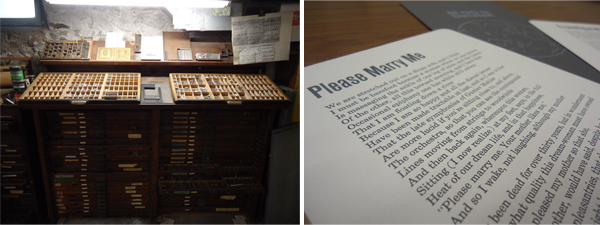
My mother was the village librarian in Parma, Michigan, where I grew up, and I was always surrounded by books. There was a book, a history of the village called CRACKER HILL CRUMBS and I remember my mother telling me that the Friends of the Library owned the plates from which the book had been printed. They were, stereotyped plates (or perhaps photo engraved cuts) taken from forms built up out of linotype slugs. I didn’t know the exact name for those things when I was a little boy, but I do know that one of my earliest memories of the library was thinking about how this thin little volume existed, somewhere, in the form of 196 metal plates on galleys in Brooklyn, Michigan at the Exponent Press. So that was always there, the idea that books were made, that metal and pressure and gears were involved.

Boxcar Press spoke with a group of inspiring printers to find out how they made the transition from hobby to career when it comes to letterpress printingBoxcar Press spoke with a group of inspiring printers to find out how they made the transition from hobby to career when it comes to letterpress printing

I did not get into the whole thing as part of any clear plan. I just couldn’t remember a time when I wasn’t fascinated by printing and by how books are made. I gave different people different explanations for why I had bought the press, but really, it was just something that I had to do. I didn’t tell lots of people about it at first, and when we had friends over for dinner one night I invited them down to see the press. My friend Ben, who I had known by then for 7 years looked at the press and then turned around and offered me his hand. “Hi,” he said to me, with a look of amazement, “I don’t believe we’ve ever met before.” That’s how I felt, too. Like, when I bought the press, I was meeting myself for the first time.

My wife and I immediately decided we need to professionalize. We couldn’t exactly believe we had just spent $1200 plus travel on an antique print shop. In 2005, letterpress was still very new as a product. That’s a weird, but true, description. The industry had collapsed by 1993, and in the early 2000s letterpress was as dead as it ever was going to get. There were craft printers in major urban centers, and some shops who still had letterpress equipment, but Martha Stewart (ie the Broad Public) was only just re-discovering the form.

When we set up Manchester Press in 2005, I remember that our Google Ads regularly appeared on the first page of search results for “letterpress”. The broad public was just starting to think about letterpress as a luxury printing option. We figured out how to get plates made at Owosso Graphic (just north of us!), we made some sample wedding invitation designs, got a few clients, and did some jobs. We quickly made back the money on the press.

But by 2006, letterpress shops just started sprouting everywhere. And I realized that I had a day job teaching, a night job writing, and neither my wife nor I had any real design training. I wasn’t always happy with my presswork, and I just knew that we weren’t going to be able to compete with the really great shops that designers were setting up on their own. Boxcar Press, and its amazing products, figured heavily in my decision to pull back from full-time press work. I didn’t want to make an inferior product.

We went from almost full-time down to hobby pretty quickly. I was obsessed as ever with the press, and with learning about type and design, but after the short burst of business we did, I didn’t feel any pressure to justify having a press. I wanted to learn, and to get good at it.

So, I spent time after work on floor 2a East of the University of Michigan Graduate Library where the letterpress printing books are shelved. And I started reading. I read everything I could from Joseph Moxon to Ralph Polk and his textbook. At the same time, my friend Jason Polan was building a career as an artist in New York, and we started developing projects to do together on the press.

When the opportunity came up to drive down and profile Theo Rehak at the Dale Guild, I just did it. I wrangled a grant, drove all day, slept on Jason’s couch, spent a day in New Jersey with a recording device, and wrote for a month. That long essay, “The Last Man for the Job”, wasn’t something I had to develop or think through. It was exactly what I had to say at that moment.

That’s what the press is for me now. I try not to compete with what every one else is doing. I just try to add the thing I can add. I’m not a printer who writes. I am a writer who prints. I like to think that even if I am never a great printer, I’m a pretty good chronicler of the movement because I understand it with a level of detail most other writers wouldn’t have the inclination to acquire.

Boxcar Press spoke with a group of inspiring printers to find out how they made the transition from hobby to career when it comes to letterpress printing

I try to only do things that I am compelled to do. I try not to do things I feel like I SHOULD do, or that would be GOOD for me, or my career. I try to focus on things I MUST do. Obviously everyone has to eat. I try to diversify my income, I try to follow a lot of threads and see where things take me, I try to keep my options open. But mostly I am stubborn and I want things the way I want them. There was a printing press shaped hole in my life. I filled it. I did what I felt compelled to do.

Amy Arndt Lesniewicz – Alice-Louise Press

Ultimately it came down to the fact that there were not enough hours in the day to have another job on top of trying to run a business and get orders out promptly. It got to the point after 6 years that if I didn’t take the plunge or figure out a way for there to be an eight day week, it was going to start hurting working relationships that I have built up over the years. I definitely had enough work to support the choice to quit my other job, and although it was scary not knowing if the good success would continue, it gave me the time to make sure that it did. One of the biggest recommendations I have for people is to grow slowly and avoid excessive overhead whenever possible.

Boxcar Press spoke with a group of inspiring printers to find out how they made the transition from hobby to career when it comes to letterpress printing Boxcar Press spoke with a group of inspiring printers to find out how they made the transition from hobby to career when it comes to letterpress printing

If you’ve got a story about your transition from hobby printer to career pressman, please tell us about it in the comments section below!

Magnificent Printings of The Mandate Press

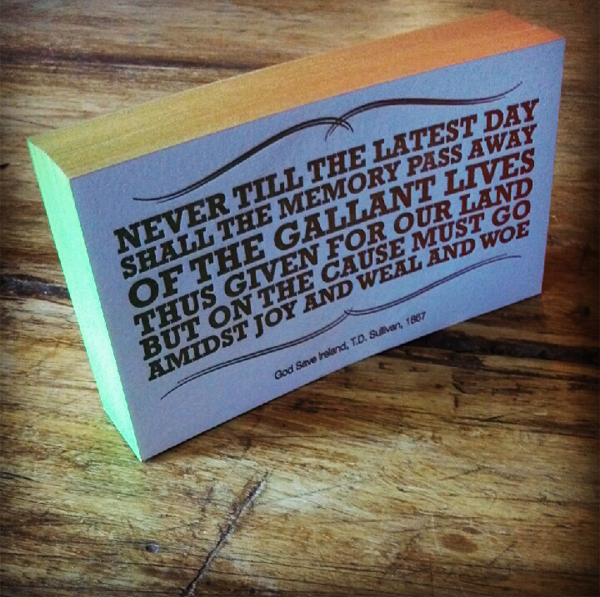
Today George Graves of The Mandate Press gives us a look at how the beginnings in hand-processing plates to running automatic presses (and the joys and headscratchers that go with it) gave him a sharp eye, a cool sense of printing logic, and a overflowing passion for all that is letterpress. We sat down with George to go over the finer details of press work, polishing opinions of modern letterpress, and of course the cool happenings of the AIGA Salt Lake City.

George_Graves_IMG2

(left photograph courtesy of Angela Klempner)

EAST MEETS WEST I’m an East Coast boy with Maine roots, some Boston blood, and a passion for craft and quality.

LOVE AT FIRST SIGHT My faculty advisor and typography professor, Cynthia Roberts, first introduced me to letterpress after recognizing my appreciation for handwork. This was during my first or second year in the design program at Endicott College. It wasn’t until the second semester of my senior year that I was able to get my first taste of printing thanks to an introductory course at another school across town: Montserrat College of Art.

I spent my time in that course learning the basics of hand setting type and operating a treadle-powered C&P and a Vandercook SP-15. My first real exposure to photopolymer plates came when I printed a nine piece series of two-color posters for my senior thesis at Endicott. Limited by a college student’s budget, a tight schedule, and the need to hand-process each plate, that project taught me the finer points of imperfections and “happy accidents”.

George_Graves_IMG16

In the spring of 2011, I was offered a 90-day internship at The Mandate Press in Salt Lake City, Utah. It would be a nearly 3,000 mile cross-country trek, in a 20-year-old Volvo. I couldn’t remember ever being further west than New York, but it was also the one gig that I had told myself I would move anywhere for. My moment of truth had arrived.

George_Graves_IMG15

I started at Mandate in late June, it had been a year since the last time I had cranked a press, and I quickly realized just how little I knew. After I had reacquainted myself with the Vandercooks, I stepped up to our automatic presses.

Expecting to have some aversions to printing other designers’ work rather than my own, it was somewhere in the process of learning to operate the automatic presses that I realized the design and printing of a project were equally important pieces. My confirmation that this is what I want to do with my life came from making that discovery for myself and finding an intense pride in the trade I have chosen and the work I do each day.

George_Graves_IMG14
George_Graves_IMG7

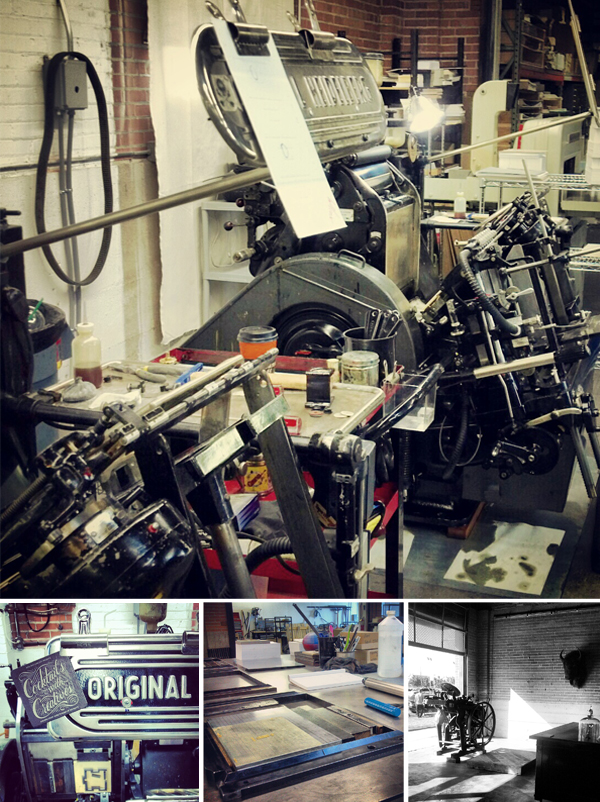
BRILLIANCE IN THE BEEHIVE STATE The Mandate Press is 10 blocks south of downtown SLC in a brick and mortar building on Main Street. The shop is just under 8,000 square feet and split between front and back. The front end of the shop serves as a gallery space, storefront, and our “office” space while the production all happens in the back. We have two glass garage doors in the front with a treadle powered platen press (a Chandler and Price and a Challenge Gordon) sitting just inside each one. While we run almost every job on automatic presses, we do run some lower quantity jobs on one of our Vandercook 4s in the front end of the shop. We actually have two 4s but one is in the middle of a rebuild.

Besides the four presses in the front of the shop, we have five automatic presses in the back. Two Heidelberg Windmills, Two Heidelberg Cylinders and a Frontex Automatic Cylinder. All built in the 50s or 60s, our lineup of automatics each has different muscles to flex. While the windmills are our workhorses and we have them cranking all day every day, our cylinders allow us to do larger work, heavier floods, and deeper impressions. The more comfortable I get with each press as I learn it, the more I appreciate the variety of abilities and each press becomes another tool in the shed or weapon in the arsenal.
George_Graves_IMG12

George_Graves_IMG7

As cheesy as it might sound, my favorite part of the shop is literally just being a part of it. From being a part of the planning that went into the show now hanging in our gallery, to learning the ins and outs and quirks of each press, to clearing room in the back of the shop so that we could drop our newest press into place with a forklift, each day at the shop reaffirms my desire to be a part of it. Especially considering my own doubts and the doubts that others had about my ability to make my letterpress goals a reality.

George_Graves_IMG4

PRINTING MENTORS I owe every part of my daily routine to Ben Webster – owner, bossman and original pressman of The Mandate Press. He taught me the in’s and out’s for routine setups, he has patiently helped me develop the skill set necessary to solve new problems as they arise, and we are constantly discussing and polishing our opinions about the finer points of modern letterpress.

George_Graves_IMG6

One of my biggest motivations at Mandate is a desire to repay Ben for the chance he took on an East Coast Luddite after a single Skype interview. I don’t think I’ll ever be sure if our chat really went that well or if he just wanted better access to fresh New England seafood.

Although Ben is the most obvious mentor of mine, I can’t forget the people that encouraged me to consider this path in the first place. Without the support of a core group of my professors at Endicott College (Specifically: Cynthia Roberts, Sanford Farrier, Larry Volk and Barbara Burgess-Maier), I may have never seen my current career path as a realistic option. Without Sarah Hulsey’s course at Montserrat College of Art, I might still be itching to try my hand at printing. And, although it was never a “mentorship” of any sort, without a heads-up from Mike Dacey of Repeat Press in Somerville, Massachusetts, I wouldn’t have known about the internship at Mandate. I will always be thankful for the role each of these people have played in allowing me to connect the dots on my path.

George_Graves_IMG12

George_Graves_IMG8

DESIGNER IN THE PRINTER As the Lead Printer at The Mandate Press, I don’t currently have the bandwidth to do any design for the shop but I try to stay active in design outside of Mandate. In June, I joined the board of AIGA Salt Lake City as Membership Director. Just recently, I designed a piece for a gallery show at the shop, and each year, I try to design a piece as a thank-you for those who support my Movember efforts.

THE CREATIVE PROCESS In a word: inefficient. I run in circles with too many different ideas and too many different sketches that get scanned and tweaked and printed and altered and scanned and tweaked etc, etc, etc… Until the final piece comes together during the last 5-10% of the process. Maybe one of these days I’ll streamline my design process but, for now, I’m content to focus my efforts on my performance in the pressroom.

George_Graves_IMG13

PRESS HISTORY My first press is an 1880s Kelsey Excselsior tabletop press. When I started working with letterpress, it came to light that Red, a friend of my grandfather, had the press just sitting in his basement collecting dust. Not sure what Red wanted for the press, my dad and I went ahead and made plans to go get it. Red had inherited the press from his father, an old union printer who did some hobby printing at home, and it turned out that he was happy just to see the press go to a happy home. What I didn’t realize was that our haul included six cigar boxes of wooden type, a couple drawers of printer’s cuts and a small cabinet of lead type. After paying in handshakes and friendly banter, we headed home with the van riding low.

A trip to John Barrett’s Letterpress Things in Chicopee, Massachusetts quickly rounded out my small shop with a Hamilton cabinet, composing stone, and a few other odds and ends. I barely got things set up at home in Maine before heading to Salt Lake City so the press is in my dad’s custody now and he has been patiently tracking down rollers to fit the press. The press is old enough and the dimensions are odd enough that he has been sent two sets of misfit rollers and is waiting on the third round now.

PRINTING FEATS My number one point of pride is simply the fact that I packed up and moved across the country on the off-chance that I might hack it as a letterpress printer. Making that choice and now seeing the progress I have made as a printer is extremely gratifying.

From less of a selfish standpoint, my biggest point of pride would have to be the show currently hanging in our gallery space at The Mandate Press. We have held a variety of events in our space but this was our first curated, letterpress specific show. We asked 21 artists to create a 2-color piece (Red 032 and Cool Grey 6) within the theme of “The Ghost in the Machine”, which we then printed in-house. The variety of interpretations and styles were held together by the consistency of paper, color, and the loose theme. Being involved in every aspect of the show from the early planning stages, to printing promotional materials, to final set up for the show made the opening night feel like that much more of a success. The prints from that show are still available for purchase from our Big Cartel store or in our Salt Lake City storefront.

George_Graves_IMG10

BOXCAR’S ROLE  Although we do have an assortment of type – both wood and lead – and printer’s cuts at Mandate, we use photopolymer plates for all of our client work. I hate to place those plates on anything but a Boxcar Base. In a commercial shop, where we pride ourselves not only on the quality of our work but also on our efficiency, the Boxcar Bases are one of the most useful tools in the shop because of their grid. When running two or more colors on a job, the grid allows me to quickly drop the next plate into place even if I’m running that plate on a different press.

George_Graves_IMG5

SHOP TIPS “Slow is smooth and smooth is fast” ~ Phil Dunphy, Modern Family

Ben will quote this here and there around the shop and although its source is amusing, the point made is incredibly relevant. With the quantity of work that we see come through the doors at The Mandate Press, it could be easy to become focused on the timeline of each job and just push things through the shop. By slowing down and taking our time with each setup, or any process around the shop for that matter, the jobs run more smoothly, curveballs are eliminated, and things actually get done more quickly.
George_Graves_IMG11

George_Graves_IMG3

WHAT’S NEXT We are just now catching our collective breath from the efforts put into The Ghost in the Machine as well as a heavy shop involvement in AIGA SLC’s second Design Week. Jim Sheridan of Hatch Show Print visited SLC in early December to give a lecture and used our space to do a workshop as well. Hatch was one of the first shops I was exposed to when I first became interested in letterpress and getting a chance to meet Jim and work with him is an opportunity I never really expected to have.

Big round of thanks to George for letting us take a sneak peek at The Mandate Press!

Ink Meets Paper: A Story Behind Every Card

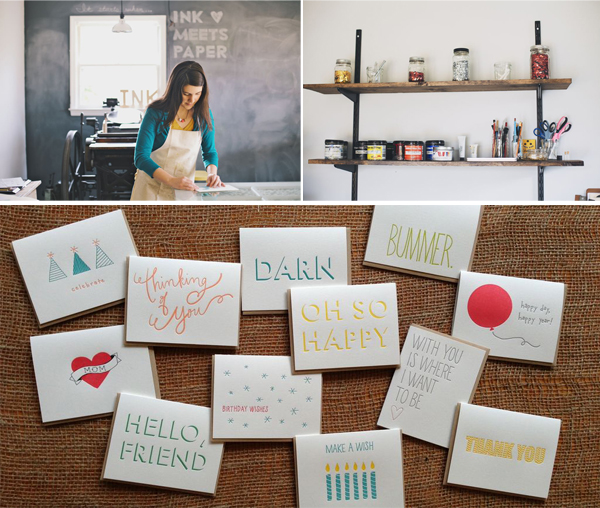
If you’ve followed the world of letterpress this past year, you’ll recognize Daniel and Allison Nadeau, the pair behind Ink Meets Paper.  The former designer & English major team turned letterpress powerhouse become a duo to watch this year, as their innovative “Every Card Has A Story” films (which capture the detail and work that goes into each piece) are receiving rave reviews. Their work is as sharp as an X-acto, colorful as a Pantone Color Guide,  and they’re a team with a penchant for letterpress brilliance. Daniel and Allison sat down between runs to talk shop and about the little things of letterpress that make their world go ’round. And don’t forget to say “Hi!” to them as they’ll be making their first National Stationery Show appearance in New York City this coming May (Booth#2267)!

DanielNadeau_IMG1

CLOSE UP WITH DANIEL & ALLISON We’re husband and wife, Daniel and Allison Nadeau. Daniel’s background is product and interaction design, and I was an English major. We grew up in Nashville, TN, spent a few years in Savannah, GA, and ended up in Charleston, SC.

FROM CORPORATE TO CREATIVE Our interest in letterpress started with a desire for hands-on interaction and creation. We both had corporate jobs where we sat in front of computers most of the day, and longed to create something more tactile and physical. After taking a printmaking and letterpress class at a local art studio, I was hooked.

DanielNadeau_IMG5

PRINTING IN THE PALMETTO STATE Our shop is in our house, which is in the Park Circle community of North Charleston, SC. We had initially looked into renting a storefront studio space, but the timing just didn’t work out. Instead of continuing the search, we converted a spare bedroom into a studio (added French doors to allow access for the press, pulled up carpet to expose the concrete floor, and added a concrete overlay). Keeping the studio in the house was probably one of the smartest moves we made. It allowed us to grow slowly (without stress from additional rent) and made it easy to print at crazy times (we both had other full-time jobs at the time, so there were many late nights printing). The studio is also climate controlled, which is a huge perk for the hot, humid Charleston summers. We’re lucky to have lots of natural light and a really nice view of the backyard.

THE CREATIVE PROCESS We are always creating. Our greeting card line keeps us pretty well aligned with the retail industry in terms of product releases ( i.e. Christmas cards in May, Valentine’s cards in September, and so forth). Daniel and I usually run through sketches, concepts and ideas to narrow down a direction and refine from there. Most of our card designs are hand drawn first, and then scanned and vectorized to be made into photopolymer plates.

DanielNadeau_IMG3

Our production process is a bit different, as we are really interested in the dialogue that occurs when a customer wants to learn more about the card they purchased, or received. One of the ways we have addressed this dialogue was to create Card Stories. We make a unique video story for each of our card designs (accessed by scanning a code on the card back or by entering the Story Code number at our website). This meant, as we printed, we would also film (and eventually edit) the printing process. As our volume has increased, we are working to find other ways of letting our customers know what goes into each card. Our mobile site has always been closely tied to each product, and we’re excited to continue exploring how the digital and physical can support one another.

FULL TIME FUN We’ve both been focused full time on Ink Meets Paper since January of 2012. We also work as graphic/web design freelancers, and Daniel does programming as well.

PRESS HISTORY Summer of 2008 became the season of the great printing press search. We scoured forums and Craigslist ads throughout the South, hoping to find a floor-sized platen press. Daniel was so set on finding one that he made a list of every antique store in the state.

DanielNadeau_IMG2

Finally, we located an 8×12 Chandler & Price at a print shop in Jacksonville, FL that was closing out the letterpress portion of its services. Hearing stories from and talking with a third-generation printer was an incredible experience– such knowledge and so much history. Good friends helped us move the press back to Charleston (and let us keep the press in their garage until we worked out a studio space).

PRINTING FEATS Probably our biggest accomplishment is that we’re both self-employed and working together. While it’s challenging at times, it’s so rewarding to be able to work from a home studio, refine our business, and explore new opportunities with each other.

DanielNadeau_IMG6

We are so honored to be a part of the letterpress community, and have always found everyone to be open and willing to share knowledge. To complement fantastic sites like Letterpress Commons, we also organized the Letterpress Hotline in early 2012. It’s a volunteer-run telephone helpline so printers can call and talk to another printer if they’re ever in a sticky situation.

DanielNadeau_IMG4

BOXCAR’S ROLE We use a Boxcar base and order our plates and ink from Boxcar. Boxcar’s top-notch customer service and easy online ordering mean our plates are one less thing we have to worry about. Not to mention, Boxcar’s online letterpress training videos and press manual PDFs (now a part of the Letterpress Commons) were extremely helpful as we were venturing in to the crazy world of letterpress printing. We’re big proponents of sharing information and helping others and love that Boxcar holds those same views.

SHOP TIPS Be thoughtful and don’t be afraid to go slowly (both in business and in printing). Building a business takes time, and it doesn’t happen overnight.

WHAT’S NEXT Ink Meets Paper will be making its first appearance at the National Stationery Show in May, Booth#2267.

DanielNadeau_IMG7

A big round of thanks out to Daniel & Allison for letting us get the full story on Ink Meets Paper.

Photography courtesy of Olivia Rae James.

Inking up with Shauna Rue of Purple Ink Press

From a bizarre love affair with metal plates while crafting tailored social stationery to the dream of running a small business, Shauna Rue of Purple Ink Press exemplifies the drive and playfulness of letterpress printing. We sat down with Shauna to catch a glimpse of how all of the pieces came together to capture the happy-go-lucky heart of letterpress.

Shauna_Rue_IMG1_1


BEAUTY IN THE BAY STATE My name is Shauna Rue and I am the owner of Purple Ink Press, which I created in 2010. I design and print customized letterpress invitations, baby announcements, business cards, and all types of social stationery. I live and work in the Worcester area of Massachusetts. I have been married to my husband, Mark, for 7 years, and we have two beautiful children together: Wyatt, 2, and Emerson, 8 months.


FOR THE LOVE OF LETTERPRESS Like many new printers, I first discovered letterpress when I was looking for my own wedding invitations back in 2005.  Two years later, I was still OBSESSED with letterpress, and I found John Barrett with Letterpress Things out in western Massachusetts.  I took a few classes and I was hooked―John wouldn’t sell me a floor press until I put my time in on a tabletop, so I came home with my Kelsey 6 x 10, a cabinet, and drawers of type. I printed incessantly on nights and weekends and during vacation time from my corporate job, practicing the craft and familiarizing myself with different papers and plates.

In 2009, the timing was right so I left my full-time job and found a Chandler & Price 10 x 15 floor press in need of a good home.  I have been printing happily since then.

Shauna_Rue_IMG2_2


PARADISE IN THE PRINT SHOP My print shop is in the basement of my home, which luckily has great light and space.  I actually love having the presses at the house, since I am a night owl and like to print at all hours.  With that being the case, I still love using rubber based inks that I can keep open on the press.  There is always a dog at my feet and I have drawers and drawers of type that I need to organize. I tell myself it’s all part of the creative process!

THE CREATIVE PROCESS The majority of my work is custom wedding invitations and accompaniments, so I like to talk to the couple about their wedding―when we can’t meet in person, we’ll talk on the phone or through email.  I like to gather the details before I draft an idea for the invitations. To me, seeing a picture of the dress is often the most useful visual for creating an invitation suite that best reflects the event. From there, I put my ideas on paper―I still use a sketchbook and pencil to flush out my ideas before putting them on the computer. I always keep in mind to design to the letterpress’ strengths―i.e., I’ve only made the mistake of printing light ink on dark paper once!

FULL TIME FUN  I design and print [and] yes, I’ve been printing full time since 2010.  I can’t believe Purple Ink will be celebrating its third birthday in February!  This year, however, I took an extended maternity leave, so I only printed a handful of select projects.

Back in April, I finished printing a job and went into labor 5 hours later, so I knew I needed to slow down a bit after the birth of my daughter.

Shauna_Rue_IMG3_2

PRINTING FEATS My biggest accomplishment was deciding to start and run a letterpress business full-time – that was very scary for me, but I am so happy that I took the plunge! Everything else is an extension of that decision and I feel lucky every single day I am working. Running a small business has been a dream come true, and I have the luxury of making every job unique and customized to each customer. To me, it is a huge accomplishment to see genuinely ecstatic reactions to my work or hear from a couple that I captured the true essence of their style, love story, and wedding through my art. I love being able to be creative and constantly work at my craft and try to improve. And being interviewed for a blog such as this one or speaking at a local college as a guest art professor definitely makes me proud!

BOXCAR’S ROLE The deep relief base and photopolymer plates, baby! At the beginning of December, I just started the process of transferring my entire shop over to polymer: I love that the plates can be recycled at the end of each job and the fact that the platemaking process is less taxing on the environment.  I had dabbled with photopolymer in the past, but I held onto a bizarre love affair with metal plates. Happy to have finally seen the light! My favorite shop tool―hands down―is the Boxcar roller gauge.

Shauna_Rue_IMG4_1


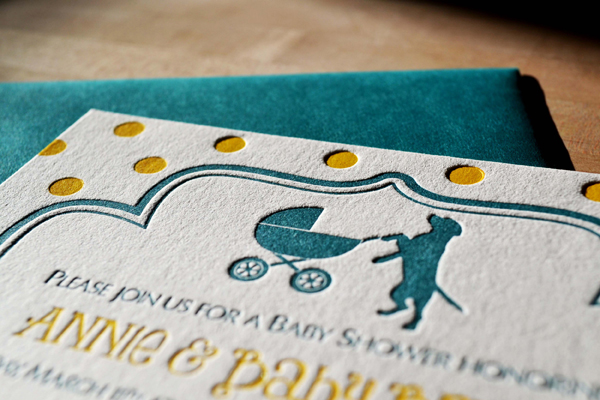
SHOP TIPS When I first started my stationery line, I tried to come up with cards that I thought people would like and it was a disaster. I quickly learned that if I print what I like, someone out there will find it. One of my most popular baby shower prints is the dog pushing the baby carriage, which I originally designed for my own shower invitations because I wanted to incorporate my current ‘kids’―my yellow lab and my French bulldog―into the celebration. Sure enough, I’m not the only crazy dog lover out there, and I have since printed bulldogs, dachshunds, cocker spaniels, and countless Labradors pushing baby carriages.


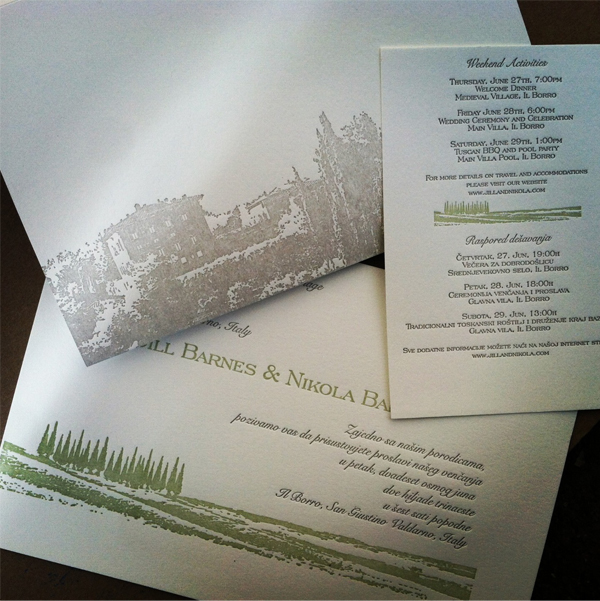
WHAT’S NEXT I am very excited for 2013. I re-launched my website in January, which is perfect timing after my extended maternity leave. Recently, I have been designing invitation suites using a combination of paper textures, finishes, thickness, colors, fonts, and materials. I’m also doing more with ready-to-order letterpress cards and add-ons to invitation suites, such as letterpress coasters, table signs, and place cards for weddings. I can’t wait to show them off! I have definitely evolved over the years and in 2013 I really want to encourage my customers (and brides everywhere!) to be unique, creative, and fun. I love how all of the pieces of a suite eventually come together beautifully and can truly capture the personality and heart of a wedding or event. A goal for my bridal customers is to create wedding invitations that will make guests excited about their wedding!

Some other plans for 2013 include continuing to work with some charities that I partnered with in 2012. Giving back to my community and organizations that are close to my heart is an important aspect of my life and my business. In an effort to extend this sentiment to my customers, I am going to offer couples the opportunity to donate to registered charities in exchange for letterpress cards, coasters, and other specialty items. I’m trying to make 2013 the year of giving back!

Huge round of thanks out to Shauna for letting us catch a colorful glimpse of Purple Ink Press!

Boxcar Talk With Annika Buxman

There’s a vibrancy when Annika Buxman of De Milo Design Studio & Letterpress speaks about braiding her foci of letterpress,  responsible printing, faraway homelands, and her support of Fair Trade paper. Deftly she passes from one story to another, entrancing us, while her C&P mirrors her movements. Paper to ink. Printed piece to hand. Annika paused the press so we could ease in a few curious questions into the extraordinary printing tapestry around us.

THE CREATIVE CASE OF ANNIKA BUXMAN Machinery is in my blood. I mostly grew up in Bakersfield, California in the 1970’s. At that time the landscape, even in town, was covered with functioning oil wells. The “head” on a long “neck” was constantly moving up and down like a gargantuan horse leaning down to drink. I named dozens of them and felt a special kinship with these “creatures”. The oil wells combined with the farm equipment in my grandparents’ barn made me feel at home with wrought iron and rust. I didn’t learn how to use a computer until college in 1988, so mechanical rather than digital functionality is imprinted in my brain.  A completely different childhood experience from Bakersfield was being born in Africa (Kinchasa, Zaire) and having those images and stories around the house. My family also lived in Manila, The Philippines, right after the revolution in 1987 and traveled around that part of the world for a year. Those experiences gave me a strong sense of poverty in developing countries. But it seemed like too big of a problem to solve. When I learned about how small businesses can make a difference through the practice of fair trade it was the perfect fit for De Milo Design.

Locally, I enjoy teaching the art of letterpress to people in my studio and working on custom invitations, business cards and personal stationery. Globally, I’m committed to promoting cross cultural business relationships with women in developing countries through the development and sale of their handmade paper via my fair trade and eco paper line “Sustain & Heal.”

LOVE AT FIRST SIGHT I first saw letterpress printing in the gallery at Art Center College of Design where I was a student in 1993 and was fascinated. I took their Archetype Press class. I thought it was just a fun elective. I never thought I would do it for a living so I didn’t pay very close attention. When I started up my shop I had to go back and take the class again.

STAYING COOL IN CALIFORNIA South Pasadena, California is a small town about 10 miles northeast of downtown LA. The entertainment industry does a lot of filming here when they need the “quaint-cute-midwestern-small-town” look. The front of my street level studio has huge windows that look out onto the main boutique shopping and gallery section of town. The Goldline light rail station and weekly farmers market is just down the street and the chamber of commerce organizes art walks 4 times a year so there’s a lot of foot traffic. I treadle my C&P in front of the windows every chance I get. Working the press with the backdrop of lovely marbled fair trade papers always attracts attention.

PRINTING MENTORS My first printing mentor was Regis Graden. I met him just in time because he died a few years later. But in those few years my skills improved by leaps and bounds largely due to his input. When I called him with a question often he would say “I could tell you but it would be easier to show you. I’ll be there in 20 minutes.” Here is a bit more about him on my blog. Today my mentors are other printers like me who are each doing their own thing with letterpress. Close to my studio there are at least a dozen printers — Maude Press, Lala Press, Anenome Press, Fugu Fugu Press, and Papermum Press, just to name a few. And we all rely on local printing legend Gerald Lange. The International Printing Museum puts on an annual printers fair and it’s fun getting together with other local printers to talk shop and exchange advice. The Ladies of Letterpress conference this past August provided me with a host of contacts and I love their discussion board.

THE CREATIVE PROCESS The unexpected juxtaposition of materials is the most fun way for me to design. At Art Center I learned the basics of a good layout (first, second, third read, and dynamic “white” space) and picked up an appreciation for meticulous typography. Applying those skills to combining different materials is my favorite way to design. Most of my work ends up being a collage of some sort. I could get a PhD in adhesives!

FULL TIME FUN I am both a designer and printer, and I’ve been printing full time since 1998.

PRESS HISTORY I bought a 8×12 C&P Old Style Treadle Press from the International Printing Museum in Carson and drove it to Pasadena on Los Angeles freeways on a little trailer that was only rated to carry 500 pounds. Dumb.

PRINTING FEATS In 2007 I designed and launched a line of fair trade and eco friendly papers called “Sustain & Heal.” It primarily features handmade & handmarbled papers and a specially made for letterpress Jute sheet. Later I traveled to Bangladesh to meet with many of the artisans who make the paper and see what a huge difference it makes in people’s lives when we buy fair trade. Taking “Sustain & Heal” to the National Stationery Show and bringing the message of fair trade to people there for the last six years has been a huge undertaking. I’m terrible at marketing and showing my work. I dread public speaking and talking to strangers, especially when they stare at me blankly after my passionate little speech about fair trade. Doing this show has been an area of personal growth and I’m proud that I rise to the challenge year after year.

BOXCAR’S ROLE When I first launched my website in 1999 there were not many other letterpress websites out there. Boxcar made me feel like I wasn’t alone, or crazy, to be doing what I was doing. They also gave me a laugh with the “What is Harold wearing” section. They continue to be ahead of the curve and leaders in this industry. Their habit of eco-friendly practices inspire me to do the same.

PRINTING ADVICE Regis [Graden], my first letterpress mentor, used to say “You know the only sure way to not make a mistake? Don’t ever do anything!” He also once consoled me when I called him with my latest printing woe, “You made a mistake? I can’t believe it. The last time I made a mistake was…let me think…ten o’clock this morning.”

WHAT’S NEXT So many “high on talent, low on bank account” folks walk into my studio each week with their wonderful designs that they want printed. Often they leave disappointed because they had no idea letterpress requires so much effort and is on the higher end of the price scale. So I’ve set up a “letterpress lab” program for people to come into the studio and print their own designs for a small equipment rental fee. So far it’s worked well with the few people who have tried it. I’m looking forward to expanding this program next year.

Again, a big round of thanks out to Annika for letting us catch a glimpse of the spectacular work of De Milo Design Studio & Letterpress!

Free Cozy Winter Vector Set

Leaves crunching under your feet, the glittering twinkle of a first snowfall, and the yummy smell of homemade cooking lets us know winter is on its way, dear letterpress lovers! So to kick off the cozy holiday season, we’re spreading the joy with a free winter themed vector set! This set includes joyful winter wishes, a determined hockey player, a festive Thanksgiving tom, and a delicious cup of cocoa to warm up your letterpress designs!  All are free for use and in both EPS and PDF  format. Cheers!

The Letterpress Roundtable VI: Letterpressing the Issue

With the 2012 election just a week away, we thought it’d be fitting to poll some of the printers we admire to see how they’re using letterpress to inspire political change. The results are in, and they’re poignant, humorous, intelligent and – above all – stimulating. We gathered some of letterpress’s best for the sixth installment of our letterpress roundtable discussion in an effort to light the way for what is yet to come. Read the stirring responses this group has to offer and be sure to tell us about your own projects in the comments section below!