To keep colors uniform between pieces in a set, we like to look at multiple pieces at the same time while running. Sometimes the arrangement begs to be slightly embellished.

A Day in our Letterpress Shop: Press Checking
Reply
To keep colors uniform between pieces in a set, we like to look at multiple pieces at the same time while running. Sometimes the arrangement begs to be slightly embellished.
Thomas Carlyle, a satirical Scottish writer, is quoted as saying that Man is a tool-using animal. And what self-respecting print shop or studio isn’t filled with many necessary and important tools? We asked a handful of talented letterpress printers to tell us about the most valuable tool in their print shop, and we got some great answers to share with you (including tips and secrets for geting the most out of these handy tools). As always, we hope to hear about the tool you can’t live without in your shop, so be sure to add your advice in the comments section below!
Mary Mashburn and Steve St. Angelo (Shop Boy) – Typecast Press
There are so many terrific tools that we’ve been given or purchased while building our business — and letterpress knowledge — that we had to think pretty hard about which is the most useful. Then it hit us at the same instant: Alignmate! (If you don’t have one yet, it’s a thin, see-through, gridded, somewhat-expensive-for-what-it-is and easy-to-lose-in-stacks-of-paper piece of plastic that makes checking the straightness of image to paper so simple, aligning addresses on envelopes such a snap, that you won’t be able to function without it).
But we figured everybody would say that, right? Not that they or we would be wrong. But it got us to thinking about tools at our printshop that have made the almighty Alignmate even better. Mary and Steve — alias Shop Boy — have very different roles at Typecast Press (she the registration, he the repetition) so it should be no surprise that we have a strong difference of opinion here.
Mary went with the loupe. A photographer friend bequeathed to Typecast Press not just any loupe but an adjustable black metal Fuji 4x job that the company had once given away as a promo. It’s overkill. Any loupe will do for magnifying the precision of the Alignmate. By pressing the loupe directly against the Alignmate, Mary can see all the way to straightness heaven. Side to side, centered. Top to bottom, ditto. Stray dots cannot hide. Of course, even without the Alignmate, the loupe is a wonder for looking at ink density (“Get me 30ccs of mag carb, STAT!”) and consistency across the printing area, or for evidence that the rollers are too high or low. And checking those things again. And again. And again.
Steve’s running joke is that Mary looks for reasons to stop the presses; he looks for reasons to keep them going. She insists her tweakiness is the real time saver. Fair enough.
But as his most important tool, Steve votes for those little double-stick foam scrapbooker squares — Uhu is our brand. These dumb little things let you print funky-sized envelopes or pre-cut coasters on the C&P in a hurry, using a Boxcar base and a polymer plate, without the fear of a nicked base and smashed metal gauge pins. Say Mary’s letterpress class from the Maryland Institute College of Art has stopped by for a tutorial on the C&P. They work exclusively on Vandercooks at MICA. About 15 students. Each has a polymer plate the size of a 4-inch round coaster. And we’ve got 90 minutes or so in which to get each kid the experience of creating 25 samples of his or her printed design. No sweat. Pick a dependable spot on the platen. Peel one side of two little squares (it’d be three squares set like gauge pins for a rectangle) and stick them to the tympan, an inch or two apart and angled in just a hair. Tape the impression side of the polymer plate to the coaster and set the coaster between the squares. Press together. Bang. You should be pretty darn close to registered. (“Alignmate!”) The squares pull up and then re-stick for micro-adjustments if necessary. Done. And … next!

I didn’t want to go with the obvious, such as one of our two micrometer composing sticks, but I wanted to get outside of the normal a bit. Hmmm. A roller height gauge is critical. Our electronic micrometer for measuring paper thicknesses and wood type height. Our killer old Boston pencil sharpener which puts a seriously long, tapering point to pencils. But overall I would pick Scotch tape. We use it to build up type (and once you get it right you can just leave it on) or woodcuts. We also use it a lot on the mylar on our Vandercooks to build up specific area a bit such as the names on a wedding invitation to give it a bit of extra punch. One small trick that is good if you have enough room around it is to double back one end (not under an area you are printing) so that you can easily grab it to pull it up after printing. We’ll often print right on the mylar, stick a piece of tape to the printed image we want to add impression and then pull it back up so we can see the exact printing area, and then cut the tape out in the right shape. This way you have a nice image to align against. Also we will often use an Xacto knife blade barely stuck to one or both sides to help us get it into position.

After much thought I’d have to say the most valuable tool in my shop right now is my cutter, a Challenge 305 with power back and digital readout. It allows me to order and cut large parent sheets in bulk, which saves a huge amount of time and money. After printing, I can trim down orders with the precision and consistency that my clients demand. The cutter cost more than I paid for any of my presses but I’d buy it again in a heartbeat – I really can’t imagine running my shop without it. I don’t have many secrets for this one, it’s a pretty straightforward piece of equipment. Get some extra knives, keep them sharp, and you’re good to go!

What I have to proffer is not the most valuable tool (in terms of expense) but it is one I rely upon and trust daily, and it has a personal history that I value. It is the lowly roller height setting gauge. I had always admired the long handled gauges used on production platen presses and when a friend of mine offered to make a dead on accurate gauge for me at Jet Propulsion Laboratories, what could I say but yes. They had made a bed plate for me a while before and it was dead on (I think they thought it was going to Mars or something).
Well, he tested the other gauges I had, historic and present, and said that they were not, um, in anyway .918 (he was a bit of a stickler) so off we went, hand-polished to .91800+/-. Somehow we ended up with about four or five dozen of these before he got sick and tired of the hand-polishing thing. I kept a couple and we sold the rest.
At any rate, I like to call it my magic gauge. Everything seems just so right when I use it. And that is just so, so reassuring on press.
Specifications on it are: Gauge is 15-3/8 inches long. Shaft is 5/16 of an inch in diameter. Mirror-polished head is precisely ground to .91800+/-. Head is beveled and measures 3/4 of an inch wide. Weight is 7-1/4 ounces. Knurled tail. Made of 303 high-grade stainless steel. Highly resistant to corrosion. Non magnetic.

Here are a couple things we use every project, every press:
Digital Thickness Gauge – Don’t guess at your packing. These are critical for knowing what you are placing in the press for packing to quickly and accurately achieve the desired impression. Ours cost about $70 from Amazon.
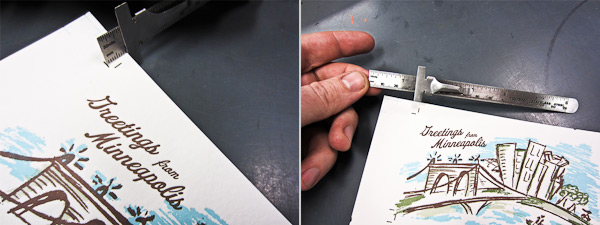
Depth Ruler – These little $2 rulers have a little sliding clip perfect for comparing the distance from crop to edge of sheet. Perfect for quick comparison side to side and head to tail of sheet to squaring things ups. Crooked printing sucks to correct later on the cutter.

Back in the day there was a printing supply company in the UK called Cornerstone, and by the 1960s they were the bee’s knees when it came to ordering sundries for serious letterpress work.
They pretty much supplied all the goods you might need, excluding presses and type. They made sets of three narrow rollers with a uniform handle so you could pull two colour proofs with a single line of 10pt type in a second colour; type cabinets with cases that were made of ultra lightweight metal with plastic liners, that ran on nylon rollers and had a safety mechanism so it was impossible to pull the case too far out and drop it; their aluminium furniture was widely used, top quality page cord the like of which we won’t see again, and the make-up galley with a spring lever that told you how many points under or over your page was, another item still in use around here.
But of all their sundries the one I prize most is the type high measuring gauge. The 10 inch square steel base is engineered flat, and connected to one side is a five inch curving arm bringing a dial gauge to a spot over the centre. This has a spring loaded contact point so that a block, be it polymer, zinc, mag, or wood engraving, placed beneath it, gives the exact height, the dial showing .918 centred at zero, and one thou increments up to twenty five thou above or below type high each side of it.
I rely on it, and every block I prepare for printing passes under the gauge before going in the chase. Old blocks, purchased with all sorts of paper packing on the back, can be cleaned and rebuilt, checked and made ready for use with little trouble. Likewise wood type, notoriously various, saving a lot of effort by checking each letter for wear before setting and pulling a first proof. Eventually every piece in the shop will have been corrected through using the gauge, but that will take a while!
My biggest saving was with a book illustrated with ten original wood engravings – all were supposed to be machined to type high by a reputable supplier. One though was twelve thou over, and considering how much work goes into creating one wood engraving, I was delighted not to crush it!

Fred Hagstrom – Carleton College
I recently asked a student how large something was and the reply was “seven and three lines.” So my most essential tool is the ruler, and I am dismayed by the growing number of people–smart, well educated people–that don’t know how to read a ruler. When I do bookbinding with groups I ask them to measure 3/8 of an inch for the spine gap. I have to quickly look around the room. Some will have 3/16, some even 3/4 but they will have 3 somethings. It is not that they are dumb, it is just that they have never made anything before, so there is a huge gap in the physical and mental skills of how things are made. For instance, body mechanics. I can show someone how to cut something, or how to print something, but I can no longer assume a basic physical understanding of how to complete a task. I end up talking about how to stand, how to push down on something etc. That is something I did not have to do years ago. I have found my print tools spread around the building, mangled when used to do something inappropriate like opening a paint can. There is little reverence or appreciation for tools because they are not understood.
Learning these skills is not just a mundane thing. There is an intellectual dimension to knowing how to do things. Too many folks in education see this as devoid of intellectual content. Some highly intelligent people lack the basic ability to complete a task. They would be liberated in an intellectual sense if they had a better understanding of work. And the digital world has only increased this problem. I hope to increase people’s enjoyment of the process, and decrease their fascination with the results-only approach. I had a poor academic preparation, but I had a huge advantage in life experience from doing manual labor. I knew how to learn because I knew how to work.

So tell us – what’s the handiest tool in your print shop? Add your comments below!
In a delightful conversation with Boxcar Press, Chris Torres of Farmwood Press saunters us through the moment of letterpress love (it involved four letterpress beauties), reveals the new plans for his family’s twin passion of photography & printing, and explains why getting dirty while printing is still oh-so-satisfying.
UP CLOSE WITH CHRIS TORRES We are a husband and wife photography team in the Atlanta area. We wanted to diversify our services, our craft, and have always loved letterpress. We thought this would be the perfect way to explore a new medium while meeting the needs of our clients.

INSPIRED BY FRIENDS Some of our close friends were letterpress printers and we adored the craft. We would go to their studio to see the process. They decided to sell their company for personal reasons and we decided to buy it from them. They taught us how to print using the machines they sold us. However, the process was perfected through help from veterans in the letterpress industry. It also helps that I come from a large-scale commercial printing background. So much of the logical aspects to printing and managing client expectations came natural to me. I have loved having a medium where I can “get dirty” again.
PRINTING IN THE PEACH STATE Our studio is currently in our garage that is a simple, small two-car garage. We have used every inch of available space to safely print. Of course, it will soon be in our new home and have a space of it’s own. We now have a New Style Chandler & Price (Omer), Vandercook Universal III (Norma), two Heidelberg Windmills (Helga and one unnamed) and a Champion 305 cutter. We love to incorporate vintage furniture from factories that is functional yet beautiful.
We have old sewing tables from a zipper factory in Pennsylvania and two old heart of pine tables that we use. We cannot wait to settle into our new space and truly make it an experience to print in. We will update you all once we are settled in!

PRINTING MENTORS Greg Carpenter, a letterpress printer in Chickmauga, Georgia who has seen it all! He has grown from a letterpress apprentice when he was a teenager and has been printing ever since. Whenever I travel up to see him for a day, I leave with so many questions answered and yet feel like a new world has been opened up before me. Also, Bob Schmidt, a local Atlanta printing repair man that has seen about everything from within the presses and the people who work them.

DAILY GRIND When we design, we do so with the clients in mind. Our desire is the create a piece that they will carry with them for a lifetime telling their future generations through these pieces. Our joy is that this may be part of their legacy. We don’t print full time, yet. We’d love to very soon, but right now, our work load is more part time. So far it’s been the perfect balance for us with our photography company that requires travel.

FOCUSED ON PRINTING We personally do some basic designing, but mostly we are just printers. We do have one designer on staff that does wonderful custom work and represents Farmwood Press when we design in-house.
BOXCAR’S ROLE We started out using exclusively copper plates. We love their history and crisp feel to the printing. However, it was cost prohibitive and we could not keep using them as it left our profit margins razor thin. We turned to Boxcar Press for their photopolymer plates and were extremely impressed. Their quality and crispness met the standards we had with copper plates. Also to add that the durability has been a surprise as well. Their turn around time and customer services has been crucial to some tight turn times we’ve had with our jobs. They have aided in ensuring that we prepare the perfect files for plating so that we can take care of foreseeable problems. We have loved working with them!
PRESS HISTORY Well, we happened on our first presses as a collection from our friends that were selling due to family changes in their life. We acquired two Chandler and Prices, one New Style one Old Style, affectionately named Omer and Maude. Also a Heidelberg Windmill, Helga and a Poco Proof Press who now lives creating pieces at an Australian print school. We have since sold Maude, our Old Style and our Poco and last year adopted a Vandercook Universal III which we named Norma, which means “pattern” or “rule”. She was cared for by another letterpress shop who loved every turn of her cylinder. Our presses are more than just tools for us to use but rather our family members.

SHOP TIPS Build your reputation organically. We thrive on personal relationships with our clients to find out their needs and working with them to provide that. Whether they are a business, designer, or a bride we take steps to meet them on a personal level. We do not do advertising but rather network with those that can bring us the work. Once they experience our quality craftsmanship and connection with Farmwood Press, we find that they come back for the experience.

WHAT’S NEXT We are especially excited about 2012! We are building a new home that will be finished in a few months. We will have a finished basement that will house both of our companies. We are extremely excited about this. We need space for our employees as we kept bumping into each other! This new space will allow us a few extra hundred square feet from the garage we were printing in, and we’ll have two dedicated areas each. It will be nice to have the additional elbow room. Commercial space has not been the wisest option for us as we work from home and have a family. This is a great way for us to keep the businesses separate yet still being at home.
A huge round of thanks to Chris for letting us get the full scoop on Farmwood Press!
As summer is starting to sizzle up, letterpress lovers, we thought you’d enjoy a free summer themed vector set! This sunny set includes a sensational seashell, a bountiful flower pattern (notecards anyone?), a sweet trio of sheep, and a sandy beach starfish. All are free for use and in both EPS and PDF format. Cheers!


While in New York City recently for the National Stationery Show, we found that not everything inspiring was happening just inside the Javits Center. With a sharp eye, there was some appealing typography in signage that was spotted during our travels. We all can appreciate a well turned font and a clever capital that gets the message across. Shown here are just four images we snapped, but we also recommend checking out the artful NYC Type, a site that reveals some of the classic lettering hidden high and low along the streets of New Y0rk City. Click on each picture on the NYC Type website for the location of each photo.

Clockwise from the top: Harrington’s Bar & Grill on 7th Avenue | Classic serifs on 42nd Street with Madame Tussauds | Houndstooth Pub on 8th Avenue | More serifs grace the Regal Theatre marquee.
The way Iowa native Elizabeth Munger of The Paper Nest speaks of letterpress, you find her exhilarated, curious, and earnest. Her voice on the relationship of paper choice and printing is crisp, bright, and even. And for good reason—after exploring the University of Iowa Center for the Book program, serendipity chanced upon her when a good friend teamed up with her to form The Paper Nest (a shop that shows lots of love to quality paper and printing). Elizabeth sat down with us to discuss the new future of letterpress, shop tips, and the heaping mounds of press fun that go with it.
UP CLOSE WITH ELIZABETH MUNGER I am an Iowa native who’s been making art as long as I can remember. It started with my obsession for drawing horses. I am a maker by nature and my hands are usually busy with some form of crafting.I have been printing for about 14 years and running the Paper Nest for three. Printing is definitely one of the things I enjoy most. I am process- oriented and love problem solving on the press.
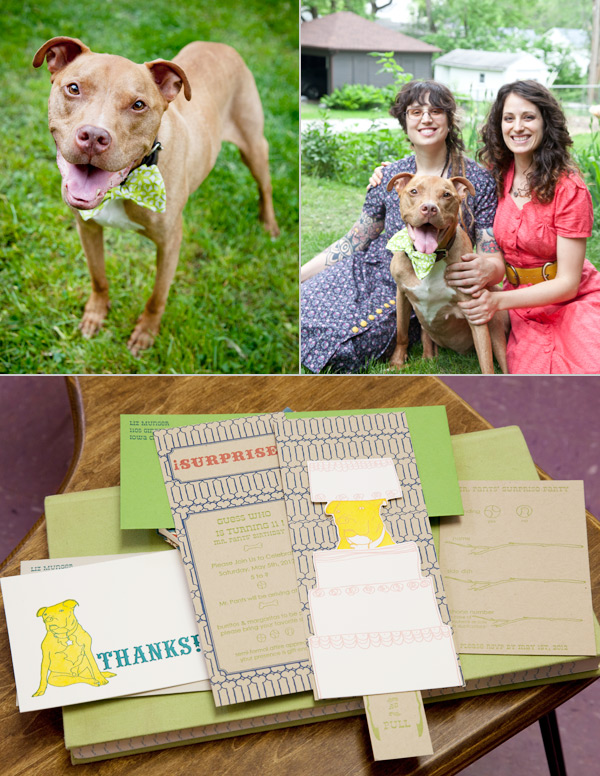 When I’m not on the press, I’m usually sewing, drawing, and doing collage/ assemblage work. If I have access, I love to make paper. When I’m not engaged in some form of art, my favorite thing to do is pal around with my dog, Mr. Pants.
INK IN THE BLOOD My first love was Intaglio. Then, a few years later, I was introduced to letterpress while enrolled in the University of Iowa’s Center for the Book. During my time there, I discovered paper and relief printing which had never made much of an impression on me before. Learning to use a Vandercook was a revelation in printing for me. I went from hand wiping plates to using a self- inking machine. It totally changed the way I thought about printmaking and I felt like I could literally print a million!
My main focus was making artist books. I spent a lot of time thinking about images & materials and how they worked together. Since I was set on editioning, I was constantly ordering paper online. I had a friend who was doing the same thing, and one day, she and I were talking about how convenient & great it would be to buy paper locally. The idea eventually worked its way into the Paper Nest and because paper & printing go so well together, it seemed only natural to make it a paper and letterpress shop.
INKING UP IN IOWA The Paper Nest is a combination letterpress and paper store. I sell printing and bookbinding papers and tools and custom letterpress printing. I ran it out of my home the first year. The Vandercook was in my home studio and my paper inventory was on a second floor studio that I rented. My first inventory order was 450 lb. and I pretty much knew then and there that I needed to find a location that was ground level. I sort of lucked out a year later when I ran into a friend of mine, who runs a bead store, Beadology, here in Iowa City. She had a space in the back that she was interested in renting to another small business. This became the home of the Paper Nest.
 Now I have a downtown location that has an alley entrance and is big enough to house me, my dog, Mr. Pants, a C&P craftsman, a huge guillotine, paper cutter and all my paper. We have been here going on 2 years now, and I am constantly humbled with how lucky I’ve been to be surrounded by such a great printing, bookbinding, & crafty community.
PRINTING LEGACIES Virginia Myers was my first printmaking instructor at the University of Iowa, and was a huge influence on my intaglio and foil printing. She is an amazing person, & without her I would have never discovered printmaking.
My other mentors would probably be the ladies I took my first letterpress class with. I had never been part of a group that was constantly doing such great work. This really encouraged me to push myself & make the best work I could.
THE DAILY GRIND As much as possible, I like to collaborate with whomever I’m working with/ for. I try to start by getting as much of an idea of what they want. Sometimes this means we work backwards from what they don’t like to get to what they really like. For example, we might start with something as vague as colors or tone to more concrete ideas such as image.
I really enjoy researching to play on historically correct images, font, and materials. I tend to draw everything by hand and then combine it with text. I try to use the computer as a tool, not as my main substrate.
PRINTER’S PARADISE I am both [a printer and designer], although I feel like I relate more into an artist/ printer category then designer. My goal is to definitely have one job: printing and talking about paper.
 PRINTING FEATS Opening up this business is probably one of my biggest accomplishments. I have to learn all sorts of things that I never thought I would. My latest accomplishment, which I am very excited about, is that I was accepted into the MFA program at the University of Iowa Center for the Book and will be starting this fall.
 BOXCAR’S ROLE Boxcar has been awesome! It is nice not worrying about making plates. It’s so convenient to be able to send out a digital file and get plates back that are so clean. If it weren’t for Boxcar, I would have more steps and be spending more time making them myself.
 It’s such an advantage to be able to call Boxcar and get advice on how to make a file better for plates. I also think their printing videos are great. I feel like they really walked me through a number of printing issues.
PRESS HISTORY Well, I was getting ready to graduate from the University of Iowa’s Center for the Book and was starting to feel anxious about not having access to a press. I started looking around and put the word out. An instructor at the Center mentioned that she had a Vandercook Universal I and I was welcome to come by and give it a look. So I went and checked it out, and that was pretty much it. I had to do some work on it before I moved it (lots of sanding rust, new rollers, etc.)
This was pretty great because it allowed me to really get to know the press and it made it seem more like mine. The other interesting thing is that she bought the press, along with the rest of a print shop, from someone who had been storing it for years, in a garage in Sioux City, Iowa. Coincidentally, I grew up in this city, so we were in the same place at the same time but never met. It took us both moving to Iowa City to meet!


SHOP TIPS My best piece of business advice is to take advantage of your local resources. If you don’t know how to do something there is usually some one in your community who is happy to help and vice a versa. This also helps to build a community. I also think being open to new possibilities and taking action is what ends up making me feel the most successful.
 WHAT’S NEXT Well I’m lucky enough to have my sister, Katie Munger, back in Iowa. She has similar interests and recently decided to come back here and help me with the Paper Nest. I’m also really looking forward to getting a better handle on the business end of things and expanding. I’m hoping to offer more preprinted products as well as custom work and binding workshops. Eventually, I’d like to be able to offer equipment rental and printing workshops.
Big round of thanks to Elizabeth for letting us get the full scoop on The Paper Nest!